
Digital Transformation Strategy Companies in Saudi Arabia: How to Choose
How to Choose a Digital Transformation Strategy Company in Saudi Arabia
No independent, published ranking of digital transformation strategy companies in Saudi Arabia exists that we could verify, so nobody can honestly tell you which one is best. What you can do is run a comparison yourself: the same written brief to three firms, the same questions, and a score on staffing, ownership terms and evidence you can check.
This guide covers what a digital transformation strategy is, why Saudi businesses commission one, the criteria that separate firms, the services to expect, how AI fits, what drives the cost, and how to measure the result. Where an answer would need a figure we could not verify from a primary source — prices, durations, ROI, market or failure statistics — it explains what drives the number and how to get a real one instead. National programmes and authorities are described as published programmes and bodies, not as evidence a project will succeed.
Digital transformation, the Saudi context, and the pillars it rests on
Digital transformation means changing how a business operates, and often what it sells, so that digital systems carry the work rather than sitting alongside it. It is a business programme with technology inside it, not a technology programme with a business case attached. That distinction decides ownership: a programme owned by IT alone produces systems rather than change.
What the term means for an operating business
For most businesses it means four concrete things. Customers can complete what they need without contacting a person. Staff stop re-entering the same data between systems. Decisions come from one agreed set of numbers. And a new product or channel can be launched without rebuilding the core. If a proposal moves none of those, it is not transformation.
What is driving the pace in the Kingdom
Three structural forces, none of them a statistic we are asserting. Customers here transact on mobile and compare your service against the best app they use, not against your direct competitors. Public services have established that a process can complete online end to end. And reporting obligations increasingly assume structured data rather than documents. Each raises the running cost of staying manual.
Vision 2030 is the Kingdom's published economic diversification programme, and digital economy development is among its stated themes. Its effect on an individual business is indirect: it shapes which sectors grow, which entrants appear, and the standard of digital service customers compare you against. We have not verified any specific target, so check the official publications before citing a figure.
Several national bodies address digital government, data and artificial intelligence, including the Digital Government Authority and the Saudi Data and Artificial Intelligence Authority. We have not verified which support programmes are currently open, what they cover, or who qualifies, so we name none as available to you. Ask the relevant authority directly; one enquiry beats acting on a stale summary.
Five pillars, and the two usually missing
A workable strategy rests on five pillars: the customer experience, the operating processes, the data and its definitions, the technology platform, and the people and governance that keep it moving. Programmes normally fund the platform and the experience and skip the data definitions and the governance. Those two are where the failures come from, because without them nobody agrees what the numbers mean or who decides.
What a strategy fixes, how it reaches revenue, and the cost of waiting
A business needs a written strategy when it has more digital initiatives than it can sequence, or when two teams are solving the same problem in incompatible ways. The document exists to decide order and ownership. Without it, spending continues and capability does not accumulate — which is a reason grounded in your situation rather than in the year on the calendar.
The problems it is actually bought to solve
In practice the list is short: work that cannot scale without more people, data that disagrees with itself, a customer journey that breaks when it crosses a department, systems that cannot be changed safely, and an inability to say what anything costs per order or per case. Each can be assessed in your own operation before you commission anything.
How it reaches revenue, and where the claim stops
The route is mechanical. More of the journey completes without a person, so fewer prospects drop out. The cost to serve each customer falls, so margin rises. Launching a product or entering a market stops requiring a rebuild, so the business can try more things. We publish no uplift percentage, because we have not verified one and any figure would depend entirely on your baseline. Measure two things instead: the conversion rate at the step customers currently abandon, and your cost per order today.
What delay actually costs
Companies that delay rarely fail from the delay itself. They accumulate three things: a longer list of workarounds that later have to be unpicked, data with no consistent history to analyse, and a widening gap between the service they offer and the one customers now expect. The cost surfaces as a bigger, riskier programme later rather than as a visible loss now.
No verifiable ranking exists, so here are the criteria you can test
We have not identified an independent, published ranking of digital transformation strategy companies in Saudi Arabia, and we will not nominate ourselves in place of one. A credible ranking would need four things: a defined population of firms, published measurable criteria, performance data a third party can verify, and disclosure of any commercial relationship between the ranker and the ranked. Nothing we found meets that standard.
The testable alternative is a comparison you run. Shortlist three firms, send the same written brief to each, ask the same questions, and score the answers on staffing, method, ownership terms and evidence. That identifies the firm best suited to your project—a more defensible way to interpret the superlative.
Qualifications worth checking
Ask which named people will work on your project and what they have personally delivered, rather than what the firm lists as a capability. Look for a multi-disciplinary team — strategy, data, engineering, user experience and marketing — because a strategy written by one discipline optimises for that discipline. Commercial registration, references you can call and a written method are checkable; seniority in a pitch deck is not.
Where local knowledge changes the work
Local knowledge matters where it shows in the output: Arabic that reads as though it was written rather than translated, right-to-left interfaces designed rather than mirrored, local payment and identity flows, invoicing and reporting expectations, and knowing which authority to ask about a data question. Ask for a sample of Arabic work and have someone on your side read it critically.
Track record, and how to read the evidence
Ask for work in your sector at roughly your scale, and for the name of the person who ran it. A checkable track record is specific: a live product you can open, a reference you can call, and a straight account of what went wrong on the project and what they did about it.
Read case studies for method, not for numbers. A number is only usable if the case states the baseline, the measurement window, the tool that produced it, and what else changed at the same time. Where those are missing, treat the figure as decoration and ask for the reference contact instead. We publish no client results of our own in this article, because that would ask you to accept exactly what we are telling you not to.
Testimonials and reviews are limited evidence on their own, especially when they appear only on the firm's website. Prefer a short call with a named former client and ask two questions that can elicit more candid answers: what did the engagement fail to deliver, and would you hire the same team again?
Certifications and partnerships, read correctly
Platform certifications show that people passed exams; vendor partner tiers show that a firm bills enough volume through that vendor. Both are a floor rather than a ranking, and partner status creates an incentive toward one vendor's products. Verify any badge on the issuing vendor's own directory rather than on the agency's site. We make no partnership, accreditation or certification claim for ourselves here.
The services a strategy company should be able to deliver
A strategy firm should be able to produce the plan and then either deliver or govern the work that follows: assessment, roadmap, data and integration, platform and e-commerce build, automation, and the marketing that puts demand through it. A firm that only writes documents hands you a roadmap nobody has tested. A firm that only builds will build whatever you ask for.
What belongs in the roadmap
A full roadmap contains, at minimum: the current-state assessment, the target operating model, a prioritised initiative list with dependencies, the data and integration architecture, the governance and decision rights, the measurement plan with baselines recorded, and a staged sequence with explicit decision points. Anything without baselines and decision points is a wish list.
Where digital marketing fits
Marketing is the demand side of the same programme. Transformation changes what the business can deliver and how the customer experiences it; marketing determines whether anyone arrives to experience it. Run them separately and you get one of two outcomes: a good service nobody finds, or paid traffic into a journey that breaks.
Search work belongs inside transformation because it is technical. Site structure, page speed, crawlability, structured data and Arabic-English handling are all platform decisions that happen to determine visibility, and it is the one channel that compounds rather than stopping when spending stops. Rebuild a platform without search in scope and rankings usually fall at launch.
Paid media belongs as the fast feedback loop. It buys answers that organic work takes months to produce — which message, which audience, which offer — and it exposes broken steps in the journey quickly, because you are paying for every visit that fails. Treat it as measurement you can act on, with a budget you control.
Social strategy matters less for publishing than for what arrives inbound: questions, complaints and comparisons in a channel that has to be staffed and connected to the same customer record as everything else. Its transformation value is being a service channel with a route into your systems, not a content calendar.
Automation, e-commerce and CRM
Marketing automation supports transformation by making follow-up happen without someone remembering: messages triggered by behaviour, lead routing, and lifecycle sequences. It can fail when installed before the process is simplified, because automation faithfully reproduces whatever process it is given, faster and at greater scale.
E-commerce and the discipline it imposes
A transaction that completes online is the clearest form of the change, which is why e-commerce work often leads a programme. It also imposes discipline the rest of the business benefits from: accurate stock, defined fulfilment, real pricing rules and integrated accounting. For many businesses the highest-return work is not the storefront but those integrations.
CRM integration turns scattered interactions into one customer record, so sales, service and marketing see the same history and stop asking the customer to repeat themselves. Its value depends entirely on data discipline: agreed field definitions, one owner per record, and integrations that write back rather than snapshot. Without those, a CRM becomes another system that disagrees with the others.
Where AI belongs in a 2026 strategy, and why we name no tools
Artificial intelligence shapes strategy mainly by lowering the cost of tasks that were previously too expensive to do at volume: classifying, extracting, drafting, summarising, forecasting and answering. That changes what is worth automating and where your people should spend their time. It does not change the order of the work — data and process still come first, because a model placed on top of a broken process automates the breakage.
Marketing and customer experience uses
The uses that hold up are the reviewable ones: drafting and variant production for human editing, classifying and routing inbound messages, summarising a customer's history before a call, answering repeat questions from your own documented answers, and segmenting on behaviour. Two rules keep this safe. A person reviews anything a customer sees, and the model answers only from sources you control.
Operational uses, and the two preconditions
Operationally the gain sits in document-heavy, repetitive work: extracting fields from invoices and forms, reconciling records, triaging tickets, drafting routine correspondence, forecasting demand. Two preconditions decide whether it is worth funding — enough data of consistent quality, and a task where an occasional wrong answer is tolerable and reviewable. Without both, this is an experiment rather than an investment.
Choosing tools without a vendor list
We have not verified adoption data for named tools among Saudi companies, so we publish no list of what leading firms use, and such a list dates fast enough to mislead by the time you act on it. Choose against your own criteria instead: where your data is processed and stored, whether your inputs train someone else's model, Arabic quality on your own text, how it integrates with the systems you already run, and how you would leave. Then run a short paid pilot on your own data before committing.
The five steps of building the strategy
Building a strategy is five steps in a fixed order: assess where you are, set goals and measures, choose the platform, plan the change for the people affected, then measure after launch. Skip the first and you get ambition without a baseline. Skip the fourth and you get systems nobody uses.
Assessment
A digital maturity assessment is an inventory plus an honest scoring. Inventory the systems, integrations, data sources, manual processes and their owners. Then score each of the five pillars — experience, process, data, platform, people — on what you can evidence rather than on how it feels. The output that matters is a shortlist of constraints ranked by what each one costs you per month.
Goals and measures
Set goals as changes to numbers you already collect, with the current value written down and the measurement method named. Three or four is enough. Pair each with a counter-measure so you notice the damage a target can cause: speed against error rate, volume against margin, automation against complaint rate. A goal without a recorded baseline cannot be assessed later.
Technology choice
Choose the stack last, after the process and data decisions, and choose on four questions. Does it do the job without customisation? Can it integrate with what you are keeping? Who can maintain it in this market? How do you get your data out if you leave? Prefer boring and supported over new and impressive. Where data residency or personal data is involved, confirm the requirements with the competent authority before committing.
People and change
Change management is not training bolted on at the end. Name an owner in the business rather than in IT. Involve the people who do the work in designing the new process. Publish what is changing and when. Train on the real task, not on the software. Keep a route for problems to be reported without blame. And budget for the weeks after launch, when the old process is gone and the new one is not yet habit.
Measuring the return
We publish no ROI figure and will not estimate one for you. Calculate it from your own numbers: recurring cost removed or revenue added each month, against the total cost of the change including run costs and your own people's time. That gives a crossover point specific to your business, which is the most relevant basis for your planning. Record the baseline before you start, because it may be difficult to reconstruct reliably after go-live.
Five sectors, and the different reason each one gains
We will not rank sectors on data we have not verified. The structural test is the same everywhere: how much of the transaction can complete without a person, and how much regulation requires you to prove. The five below gain for genuinely different reasons, which is more useful than an order.
Retail and e-commerce
Retail and e-commerce gain most directly, because every friction point is measurable in lost orders and every manual step is a cost per order. The highest-return work is usually integration between stock, fulfilment and accounting rather than the storefront itself, since that is where the errors customers notice originate.
Healthcare
Healthcare gains through booking, records, reminders and reduced call volume, which release clinical time. It also carries the strictest constraints on patient data and on what may be advertised. Confirm current requirements with the relevant health authority before scoping anything that touches patient information.
Real estate
Real estate gains by keeping listing, availability and document data current across teams working in different places, and by qualifying enquiries before a person is involved. The recurring failure is data that is accurate in one system and stale everywhere else, which is fixed by deciding where each fact lives.
Banking and finance
Banking and finance gain through faster product change, reliable reporting and stronger controls. This is the most heavily regulated category here, so the binding constraint is usually auditability rather than technology. Confirm the applicable requirements with the relevant financial authority before scoping.
Government and public sector
Government and public sector entities gain through service delivery, accessibility and Arabic-English parity rather than commercial conversion. These programmes carry specific accessibility, data-residency and procurement requirements that materially change scope and cost, so confirm the applicable standards with the commissioning entity before estimating anything.
What drives the cost, and why we publish no price
We do not publish prices, ranges or averages for this work, and we would treat any you find with suspicion. The reason is structural: the same words describe a two-week diagnostic and a multi-year programme, so an average has nothing to refer to. What we can give you is the list of things that actually move the number, so you can compare two quotes properly.
What moves the number
Cost is driven by the breadth of scope, the number of systems that must be integrated, the state of your data, how much process redesign is required, how much is bespoke build rather than configuration, the seniority and location of the people doing it, how much of the work your own team can absorb, compliance and security requirements, and how much support you buy after launch. Two quotes that differ wildly usually differ on scope and on who does the integration work, not on rate.
Pricing models, and what each one hides
You will meet fixed-price scopes, time and materials, retainers and outcome-linked arrangements. Fixed price moves risk to the supplier and recovers it through the change-request process. Time and materials keeps flexibility and leaves the risk with you. Retainers suit continuous work but drift without a defined output. Outcome-linked pricing only works where the outcome is measurable and mostly within the supplier's control, which in transformation it rarely is. Ask which model is proposed and what triggers a change order.
Whether it is worth it for a smaller business
For an SME the question is scope rather than affordability. One painful, measurable process changed well is affordable and produces the evidence for the next step; a full programme usually is not. The real constraint is rarely budget — it is having someone internally with the authority and the time to own the work. If nobody can own it, postpone rather than buy.
Choosing a GCC partner on evidence you can check
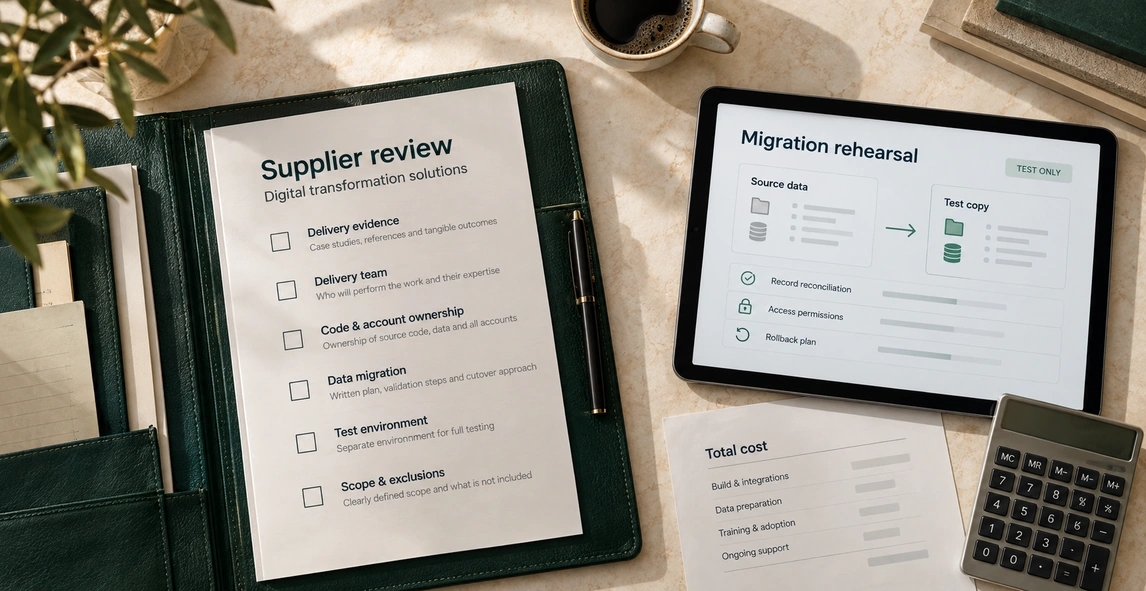
Run the choice as a comparison, not a search for the leader. Write a two-page brief describing your constraint, your systems and your budget envelope, send it to three firms, and require the same deliverable from each: how they would approach it, who would do the work, what they need from you, and what they would deliver first. The differences between those four answers are more informative than anything in a pitch.
The questions that separate firms
Ask these before signing, and get the answers in writing. Who exactly works on this, and what else are they on? What is the first deliverable, and when? Who owns the source code, cloud accounts, domain, data and analytics? What are the written acceptance criteria? How is Arabic produced and reviewed? What happens when scope changes? What does support cost after launch? How do we exit, and what do we take with us? A firm that will not put ownership and acceptance into the contract has already answered the important question.
Local against international
Local firms are usually stronger on language, market context, availability and responsiveness, and cheaper to coordinate. International firms bring scale, a deeper specialist bench and more process maturity, at higher cost and with time-zone and context distance. The honest comparison is not local against international but the named team against the named team, with the same brief in front of both.
Signals to walk away from
Treat these as reasons to stop: a price quoted before the scope is understood; a guaranteed result or guaranteed ranking; refusal to name the people who will do the work; unwillingness to give you ownership of accounts and code; case-study numbers with no baseline, window or source; a proposal that is a list of tools; pressure to sign before you can compare; and no written acceptance criteria. Each raises the same risk: discovering the real scope after you have paid.
What AY will put in writing
This is the section where we need to be most careful, so we will limit it to what you can verify. We are not claiming to be the leading or the best digital transformation strategy company in Saudi Arabia. This article argues that no such ranking can be substantiated; placing ourselves at the top would contradict that argument. Judge us against the criteria above, applied identically to two other firms.
How we work
Our method starts with the constraint rather than the technology: a paid assessment that produces a decision, a recorded baseline for the numbers we intend to move, and one sequenced piece of work small enough to finish. We put into the contract the things this article told you to ask for — named people on your project, your ownership of source code, cloud accounts, domain, data and analytics, written acceptance criteria including performance targets, and Arabic written natively rather than translated.
On client results
We publish no client names, figures or case-study results in this article. We have not verified a set we could present with baselines, measurement windows and the other factors at play, and an unverifiable number would contradict the standard we have just asked you to hold other firms to. What we will do on request is put you in contact with a client and let you ask them directly.
Scope of services and markets
The work we do is assessment and prioritisation, digital strategy and roadmapping, data consolidation and reporting, integration and automation, e-commerce and platform work, and the search, content and campaign work that sits on top — in Arabic and English. Across the GCC we treat each market as a distinct audience on shared infrastructure: one platform and one reporting line, with market-specific content, language handling and integrations. Which markets are in scope, and who covers them, is agreed in writing before work starts. We publish no fixed packages, because scope is what the fee depends on.
The 2026 trends that change a decision
A trend is only worth reading if it changes something you are about to decide. Three qualify: generative AI, privacy rules, and the expectation that context travels with the customer between channels. Each is given below with its mechanism and with the part we are not asserting.
Generative AI
Generative AI lowers the cost of routine production — drafts, variants, code scaffolding, summaries — which moves the scarce thing from production to judgement, review and distinctiveness. For a buyer that changes two decisions: how assisted output is reviewed before a customer sees it, and how much you are willing to pay for volume that is now cheap to produce. We assert no productivity figure.
Data privacy
Privacy rules increasingly determine what a digital strategy may do: what you may collect, on what basis, where it may be stored, and how long you keep it. Saudi Arabia has a personal data protection framework and a competent authority responsible for it. We have not verified the current text, guidance or deadlines, so treat this as a topic to check rather than a rule we have stated. Design for consent, minimisation and deletion from the start, because retrofitting them is expensive.
Omnichannel experience
The direction of travel is that customers move between channels inside a single task and expect the context to move with them. The requirement that follows is unglamorous: one customer record, one source of truth for stock, price and status, and channels that read and write to it. That is an architecture decision, and it is far cheaper to make now than after three channels each have their own database.
Where these programmes go wrong
The mistakes repeat and are recognisable early: no owner with authority, technology chosen before the process was understood, no recorded baseline so nobody can tell whether it worked, everything attempted at once, and the people who do the work consulted after the design was fixed. A sixth is buying a tool to avoid a decision.
On failure rates
You will see a widely repeated claim that most transformation programmes fail. We have not verified a figure or a primary source for it, so we neither repeat it nor argue against it, and the number would not help you anyway, because what counts as a programme and as failure differs between the studies quoted. The pattern is what is useful: programmes stall when no single person can decide, when the scope is too large to finish, and when the measure of success was never written down.
Employee resistance
Resistance is usually rational. People resist when the new process is worse for them, when nobody explained why, or when they expect to be blamed for the transition period. It falls when the people doing the work help design it, when the first release removes something they hate, when training covers the task rather than the interface, and when reporting a problem is safe.
The absence of a strategy
Without a written strategy, spending is uncoordinated and capability does not accumulate. Each team buys its own tool, the same integration is built twice, data ends up defined three ways, and there is no basis on which to say no. The cost is not the wasted licence fees; it is the consolidation project you will later have to run to undo it.
Measuring success, at launch and long after
Success is measured against the baseline you recorded before starting, on a small number of measures, at a stated interval, each taken from a named system with a named owner. If that baseline does not exist, the first honest task after launch is to say the result cannot be assessed and to start measuring now.
The measures that matter
Keep it to four groups. Completion: the share of the target journey that finishes without staff involvement. Effort: time or cost per order, case or ticket. Quality: error, rework and complaint rates. Adoption: the share of transactions actually going through the new process. Adoption is the one that exposes a programme that shipped without changing anything, which is why it is usually the measure left out.
Tracking long-term impact
Long-term impact shows in slower numbers: cost to serve, revenue per customer, retention, the time it takes to launch something new, and how much of the maintenance budget goes on keeping old systems alive. Review them quarterly against the pre-programme baseline, and write down what else changed in the period — pricing, competition, seasonality — before attributing any movement to the programme. Keep the definitions frozen, because redefining a measure is how a programme appears to succeed.
0 Comments
No comments yet. Be the first to comment!
Related Blogs

Best Digital Modernization Company in Saudi Arabia: How to Choose One
Why nobody can rank the best digital modernization company in Saudi Arabia, what these firms actually do, what moves the cost, and what to verify before you sign.

Best Digital Transformation Consulting Company in Saudi Arabia: How to Choose
No published ranking names the best digital transformation consulting company in Saudi Arabia. Here are the criteria, cost drivers and questions that decide it.

Best Digital Operating Model Companies in Saudi Arabia: How to Choose
Why no one can rank the best digital operating model companies in Saudi Arabia, what these services cover, what moves the fee, and what to verify before you sign.

Digital Transformation Services Companies in Saudi Arabia: How to Choose
What digital transformation services companies in Saudi Arabia do, why we publish no ranking, what drives the cost, and how to verify a provider before signing.
Digital Transformation Solutions Companies in Saudi Arabia
We name and rank no companies without verified evidence. This guide gives the criteria, the questions and the cost method you need to choose one yourself.

Digital Transformation Companies in Saudi Arabia: How to Choose One
No independent ranking settles which digital transformation company in Saudi Arabia is best. Here are the criteria and questions to decide for yourself.