
Digital Transformation Services Companies in Saudi Arabia: How to Choose
Digital Transformation Services Companies in Saudi Arabia: What They Do and How to Choose One
Digital transformation services companies in Saudi Arabia rebuild how a business operates: its processes, its core systems, its data, and the way customers reach it. We found no independently verifiable ranking of those firms, so the useful question is not who is best but which one can show it has delivered work like yours, with evidence you can check before you sign.
This guide covers what the services are, which ones a business actually needs, what drives the cost, how the work runs, and how to verify a provider. Where an answer would need a figure we could not confirm from a primary source — price ranges, project durations, ROI percentages, adoption rates — it explains what determines the number and how to obtain a real one for your own case. It publishes no ranked list of companies, and it states the conditions such a ranking would have to meet. National programmes are described as published programmes, not as evidence that any project will succeed.
Digital transformation, and the distinction that decides what you buy
Digital transformation is a change to how a business operates and how it earns: which steps a system performs instead of a person, which decisions are made from data, and what a customer can complete without contacting anyone. It matters in Saudi Arabia for the same structural reason it matters anywhere — the standard your customers compare you against is set by the best digital service they used this week, not by your competitors in your sector.
The term, stripped of marketing
Used precisely, digital transformation means redesigning the operating model with technology as the enabler, not the objective. It has three observable signatures: work leaves people and moves into systems, data becomes consistent enough to make decisions from, and the customer-facing journey completes end to end without a phone call. A programme that produces none of the three has not transformed anything, however much software it installed.
Why this reaches Saudi businesses now
Three pressures converge. Customers here transact on their phones and abandon anything slower than what they are used to. Reporting and compliance obligations increasingly expect records a manual process cannot produce reliably. And labour cost sits on every step that a system could take instead. Each of those is measurable in your own business today, which is why they are a better reason to act than the year on the calendar.
Vision 2030 and NEOM are context, not evidence
Vision 2030 is the Kingdom’s published economic diversification programme, and digital economy development is among its stated themes. Its effect on an individual company is indirect: it shapes which sectors attract investment, which new entrants appear, and the level of digital service buyers now expect. We have not verified any specific target and we cite none here — check the official publications before quoting a figure, and never present a national ambition as evidence your project will pay back.
NEOM is a large announced development programme in the Kingdom. We have not verified any measured effect it has had on digital adoption in the wider economy and we will not assert one. The honest framing is that flagship programmes raise visibility and expectations among buyers and suppliers; that is an inference about attention, not a finding about adoption rates.
Four pillars, and the two that get skipped
A workable strategy rests on four pillars: the processes the business runs on, the technology and data that support them, the people and the culture who have to work differently afterwards, and the customer experience that is the point of the exercise. Most failed programmes addressed the middle pillar thoroughly and the first and third barely at all, which is how an organisation ends up with current systems performing exactly the old work.
Digitization converts a record; transformation changes the operating model
Digitization turns a paper form into a digital one. Automation makes a step run without a person. Transformation changes what the process is, who does it and what the business can therefore offer. The three are often sold together and priced together, so it is worth asking a provider which of the three a proposal actually delivers — the answer changes what you should expect to get for the money.
Why a Saudi company funds this, and the numbers we will not invent
A company needs these services when a specific constraint is costing it money: work that does not scale without hiring, numbers nobody trusts, a customer journey that leaks, or systems that cannot be changed safely. Name the constraint first. A programme that cannot name the constraint it removes has no test for whether it worked.
The problems it actually removes
- Manual, repeated work that grows in proportion to volume.
- Reporting that different departments dispute because each system counts differently.
- Customer requests that require a person because no self-service path exists.
- Data trapped in systems that do not talk to each other, so nothing is current everywhere.
- Core systems that cannot be modified without unacceptable risk, which caps what the business can launch.
Customer experience, measured where it shows
Customer experience improves when the customer can finish what they came to do — order, book, pay, check status, change something, get an answer — without contacting you. That is visible in your own records rather than in a survey: contact volume per order, resolution time, and the completion rate at the step customers currently abandon. Establish those three before any work starts, because without a baseline no honest comparison exists afterwards.
Return and payback: what we will not state, and how to compute your own
We publish no ROI figure. Any percentage quoted for "digital transformation" as a category is meaningless, because the category includes a workflow tool and a core systems replacement in the same word. The number is determined by four things you already know: the cost of the manual work being removed, the revenue currently lost at the step being fixed, the cost of running the old system, and the total cost of the new one including support.
A defensible business case is arithmetic, not a benchmark. Count the hours a repeated task consumes in a month and multiply by the loaded cost of that time. Count the abandoned transactions at the step you intend to fix and multiply by average order value. Add the current maintenance and licence cost. Compare that annual total with the quoted build cost plus the first year of running it. If the comparison is not close, the decision is easy in one direction or the other.
When results appear, and why we quote no timeline
We do not publish durations we have not verified, and for this kind of work an average would mislead you: the same phrase covers a two-person automation and a multi-year core replacement. What determines the timing is scope, the condition of your existing data, the number of integrations, whether the old system must run in parallel, and — most often the binding factor — how quickly your side reviews and decides. Ask any provider for a staged plan that separates their working days from your decision days, and treat the second column as the one you control.
The structural point is that results arrive per stage, not at the end. A programme designed so that nothing is usable until everything is finished is a programme with no evidence until it is too late to change course. Insist that the first stage delivers something measurable on its own.
The KPIs worth carrying afterwards
Track one business outcome plus the diagnostics that explain it, measured against a pre-project baseline: manual hours removed, cycle or processing time, error and rework rate, cost to serve, system availability, and adoption. Adoption is often omitted, yet it can undermine the rest — a system may score well on availability while delivering little value if nobody uses it.
Competitiveness across the GCC
We have not verified comparative market data for the GCC and will not rank countries or claim a competitive gap. The mechanism that does apply is portability: a business whose product data, customer records and content are held in systems it controls can open another Gulf market by adding language, payment and delivery handling rather than by rebuilding. A business whose processes live in spreadsheets and a supplier’s account cannot. That is a structural difference you can check on your own systems today.
The core services, and the constraint each one removes
Providers in the Kingdom package these differently, but the underlying services are a short list: process automation, cloud migration, core business systems, AI and analytics, marketing and commerce, security, and interface design. Buying all of them at once can be a costly mistake. The useful question for each is which constraint it removes and whether you have that constraint.
Business process automation
Automation removes repeated manual steps from a process using workflow tooling, integrations or scripts. It helps where a task is high-volume, rule-based and currently done by hand — approvals, data entry between systems, document generation, routine notifications. The rule that saves money: simplify the process before automating it. Automating a bad process reproduces the same bad outcome faster and at higher cost.
Cloud migration
Cloud migration moves systems off hardware you own and onto infrastructure you rent. It matters because it turns capacity into a setting rather than a purchase, which is what allows systems to scale and to be rebuilt in pieces. It is not automatically cheaper: costs are consumption-based and rise with careless architecture, so treat cost management as an ongoing task rather than a one-off setup.
Public cloud is shared infrastructure operated by a provider, which gives the widest service range and the lowest entry cost. Private cloud is dedicated infrastructure, whether hosted or on your premises, chosen for control, isolation or a specific data requirement. Hybrid runs both and connects them, usually because one workload cannot move while the rest can. The choice is driven by data obligations, latency and existing investment, not by fashion.
Choosing a provider in the Kingdom comes down to four checks: where the data will physically reside and whether that satisfies your obligations, which services you actually need and whether they are available in the local region, what it would cost to leave, and who supports you when something breaks at 2am. Data residency and sector-specific data rules are the part most often assumed rather than confirmed — we have not verified the current requirements for your activity, so confirm them with the competent authority before you commit to a region.
ERP transformation
ERP transformation replaces or rebuilds the system that runs finance, inventory, procurement, payroll and operations, together with the integrations around it. These projects are dominated by data migration and process change rather than software installation, which is why they overrun when they are scoped as technology work. The decisive early choice is whether you adapt your processes to the product or configure the product to your processes; the second is more comfortable and far more expensive to maintain.
AI and machine learning
AI fits where a task is repetitive, high-volume and tolerant of review: classification, extraction, forecasting, drafting, first-line support. Two preconditions decide whether it is worth funding — data of adequate quality and volume, and a workflow where an occasional wrong answer is caught rather than acted on. Without both, it is an expensive experiment that produces fluent, confident and sometimes wrong output at scale.
The use cases that recur for businesses here are bilingual customer support triage, document and invoice extraction, demand forecasting, personalisation of offers, and content and translation drafting with human review. All are additions to existing processes rather than replacements for them. We have not verified adoption rates for any of these in the Saudi market and publish none.
Data analytics
Analytics work consolidates data that currently lives in disconnected systems, defines what each measure means, and makes reporting reliable enough to act on. It usually has to come before serious AI work, because a model built on inconsistent data inherits the inconsistency and presents it confidently. Most reporting problems turn out to be definitional rather than technical — two systems counting a customer differently — and settling those definitions is often the most valuable part of the engagement.
Digital marketing transformation
Marketing transformation moves demand generation from disconnected campaigns to a measurable system: one place where customer data lives, a site that converts, content that answers real search demand, and tracking that attributes revenue rather than clicks. It works by closing the loop — a lead source recorded at capture and still attached at the point of sale, so budget decisions are made on outcomes instead of impressions.
SEO fits as the part of that system that captures demand people already have. It depends directly on the transformation work: site speed, structured content, working Arabic and English versions, and clean URLs are technical outcomes, not marketing choices. In practice the same platform decisions determine both, which is why search performance is better treated as an acceptance criterion for the build than as a campaign bought afterwards.
Marketing automation supports the whole by handling the sequences a person would otherwise run by hand: follow-up after an enquiry, abandoned-cart recovery, onboarding, reactivation, and routing to the right salesperson. It is only worth switching on once the data behind it is trustworthy. Automation applied to a dirty contact list sends the wrong message to the right person, at volume.
E-commerce transformation
E-commerce transformation rebuilds the selling path so it works end to end: catalogue, search, checkout with locally used payment methods, delivery options, returns, and integration with stock and accounting. Retailers here need it because the phone is the storefront and every point of friction is countable in lost orders. The highest-return work is usually integration rather than the storefront design — stock, fulfilment and finance agreeing with one another.
Cybersecurity
Security services support transformation by making the new estate defensible: identity and access control, least privilege, patching, encryption, logging and tested backups. They belong in the design rather than added afterwards, because retrofitted security is both weaker and more expensive. If you hold personal data, legal obligations sit on top of the technical work — we have not verified which currently apply to your activity, so confirm that with the competent authority rather than with your vendor.
UX/UI transformation
UX and UI work redesigns what the customer or employee actually touches so the task can be completed without help. It matters for retention because the second visit depends on how the first one went: a returning customer who cannot find their order, reorder in two taps, or read the interface comfortably in their own language leaves quietly. Judge this work on completion rate and support contacts, not on how the screens look in a presentation.
Choosing a provider: checks you can finish before you sign
You choose by verifying rather than by trusting, and by defining what you need before you look at who supplies it. Write down the constraint, the systems in scope, the data that must survive the move, and what success would look like in numbers. Then run the checks below. These checks are most useful when completed before you sign.
Certifications and experience
Platform and cloud certifications show that individuals passed exams and that a firm meets a partner threshold. That is useful and a low bar, so ask two follow-up questions: who holds it, and will that person work on your account. Security and quality management certifications carry more weight where you have regulatory obligations. Experience matters in one specific form — comparable delivered work in a comparable system, which you can inspect and whose client you can ask to speak to.
Local market knowledge
Local knowledge matters for the parts that touch language, local integrations and regulatory process: Arabic written natively rather than translated, locally used payment and identity integrations, familiarity with the approval steps that set your schedule, and support in your working hours. For general engineering quality it matters much less. Decide which of your requirements are genuinely local and weight the criterion accordingly, rather than treating presence in the Kingdom as a proxy for competence.
Questions to put to every shortlisted provider
- Who will do the work, by name, and what else are they committed to during our project?
- What exactly is delivered at each stage, and what is explicitly out of scope?
- Do we receive the source code, repository access and documentation?
- Will the cloud, domain, analytics and advertising accounts be registered in our name?
- How will our data be migrated, and how will we verify that nothing was lost?
- What is the rollback plan if a cutover fails?
- Which parts of this are subcontracted, and to whom?
- What does support cover after launch, with what response times?
- Show us a project that went wrong and what you changed as a result.
What to ask about timelines and milestones
Ask for a plan in stages, each with a named deliverable and an acceptance test, and ask which stage produces the first usable result. Then ask the question most proposals avoid: which items are waiting on us, and what happens to the schedule when we are late. Ask what has to be true before each stage can start, and what the provider assumes about your data. A schedule with no dependency on you is a schedule that will slip and be blamed on you.
What to ask about pricing models and hidden costs
Ask whether the fee is fixed for a defined scope, time-based, or retained, and what triggers a change order. Then ask for the costs that sit outside the build fee: licences and subscriptions, cloud consumption, third-party services, migration and data cleaning, training, and support after launch. Ask who pays when a requirement is discovered late. Get the answers in writing, then compare quotes on the same total rather than on the headline number.
Portfolio and case studies
Read each case with three questions: what the baseline was, what the provider itself changed, and what else changed at the same time. A percentage with no starting point is decoration. Then verify the work exists — open the site, use the flow, check whether it is still live and still maintained. Ask whether the client approved publication and whether you may speak to them; a refusal is information.
Reviews and testimonials
Selected testimonials tell you what the provider wants said, so they indicate positioning rather than quality. Reviews are more useful in aggregate and in their detail: look for descriptions of how problems were handled, of communication during delay, and of what happened after launch. Weight a reference call you arranged yourself far above any published quote, and ask the referee what they would do differently.
Post-launch support
Most of a system’s life happens after launch, and most of its cost too. A provider with no support agreement has an incentive to finish rather than to finish well. Agree in advance what support covers, what response times apply to which severity, who holds the credentials, how changes are requested and priced, and what the exit looks like if you move to another supplier. Anything undefined here becomes an argument later.
Why this article publishes no ranking of companies
We publish no ranked list of digital transformation companies in Saudi Arabia because we found no independent methodology that would support one. Existing lists may rely on public information and criteria that are not fully disclosed. Comparing providers through verifiable criteria is more useful than relying on an unexplained ranking.
The four conditions a credible ranking would need
- A defined population: every firm that could qualify, with a stated rule for inclusion, not a shortlist of whoever was easy to find.
- Published, measurable criteria, weighted in advance, so a reader can see why a firm placed where it did.
- Independently verifiable performance data on delivered projects — baselines, outcomes and failures — not self-reported case studies.
- Full disclosure of commercial relationships between the publisher and every firm listed, including paid placement and referral arrangements.
No criteria were used here, because no ranking is published here. If you read a ranking elsewhere, apply those four conditions to it. A list that fails any of them is advertising with a numbered format, and it should carry no weight in a decision this expensive.
A testable alternative to a ranking
Run your own shortlist instead. Pick one small, real, paid piece of work — an assessment, a single integration, one automated process — and give the same written brief to three providers. Compare what they ask you, what they scope, what they refuse, and what they deliver. That produces evidence about your project, from firms available to you now, which is something no published list can do.
Enterprise, mid-market and startup work differ in structure, not in rank
We will not name firms as leaders in enterprise-level work. What distinguishes genuine enterprise capability is checkable without a ranking: delivery on large core systems with regulatory obligations, formal change control and testing, a team deep enough to survive a person leaving, and references from organisations of comparable size and complexity. Ask for those four and let the answers sort the field.
Nor will we name firms that specialise in small and mid-sized business work. The markers there are different: fixed, comprehensible scope, work that goes live in stages rather than in one event, willingness to work with your existing tools instead of replacing everything, and a senior person actually on the project rather than on the pitch. A firm structured for enterprise programmes may approach an SME project as a smaller version of a large one, which can consume a mid-market budget without providing proportional value.
For startups and small businesses we publish no "best value" list, because value is a ratio and we have verified neither half of it for any firm. Value in this segment comes from two things you can assess directly: whether the provider will start with the smallest thing that proves the idea, and whether you own everything afterwards — code, accounts, data and domain. A low-cost engagement can become expensive if leaving it is difficult.
Where AY fits, without a comparison we cannot support
AY (AY.SA) works across strategy, build, content, search and campaign management in Arabic and English. We will not tell you how that compares with other full-service partners, because we cannot verify how they work and a self-assessment has limited value. What we will do is put specifics in a contract — named people, your ownership of code and accounts, written acceptance criteria, Arabic written natively — and invite you to ask every shortlisted provider for the same four and compare the answers rather than the adjectives.
Industries, and the different reasons the work pays back
We have not verified sector investment data for the Kingdom and will not rank industries by benefit. The structural test applies everywhere: how much of the work can move into a system, how much of the customer transaction can complete online, and what regulation obliges you to prove. The six sectors below illustrate different reasons the work pays back rather than an order of merit.
Retail and e-commerce
Retail gains most directly, because every point of friction is countable in lost orders and every manual step is a cost per order. The highest-return work is usually integration — stock, pricing, fulfilment and accounting agreeing with each other — rather than a new storefront. The measurement is already in your data: completion rate by step, and contacts per order.
Healthcare
Healthcare providers gain through booking, records, results delivery and a large fall in call volume. The constraint is data: patient information carries the strictest handling requirements and the tightest limits on what may be claimed publicly. We have not verified the current requirements, so confirm them with the relevant health authority before scoping anything that touches patient data.
Banking and fintech
Banking and fintech are changed less by customer-facing apps than by what sits behind them: the ability to change a product without a release cycle, produce reporting auditors accept, and onboard a customer without paper. This is the most heavily regulated category here, so the binding constraint is compliance and auditability rather than technology. Confirm the applicable requirements with the relevant financial authority before scoping.
Real estate and construction
Real estate and construction gain by keeping listing, project, document and approval data current across teams that work in different places. The recurring failure is data that is accurate in one system and stale everywhere else. Transformation here is mostly a decision about where each fact lives and who may change it, which is organisational work supported by software rather than the reverse.
Government and public services
Public service delivery is judged on access and completion rather than on conversion: can a citizen finish the transaction, in either language, on a phone, without visiting an office. These programmes carry specific accessibility, data-residency and procurement requirements that materially change scope and cost. Confirm the applicable standards with the commissioning entity before estimating anything.
Education and e-learning
Education gains through enrolment and administration moving into systems, content delivered in a form students actually use, and progress data that lets a teacher intervene early. The part that decides whether it works is not the platform but assessment and support design — a course delivered online without either is a filmed lecture with worse attendance.
What sets the price
We publish no prices, price ranges or hourly rates, because we have not verified any and an unverified range could create a misleading budget anchor. What follows is what drives the number. That is more useful than a range: it lets you read a quote and judge whether it was priced for the work you described.
The factors that move a quote
- Scope: how many processes and systems are in and what is explicitly out.
- The condition and documentation of the existing systems.
- How much data must be migrated and how clean it is.
- The number and complexity of integrations, especially to systems you do not control.
- Whether the old system must run in parallel during cutover.
- Regulatory, security, accessibility and data-residency requirements that must be demonstrated.
- How much process redesign, change management and training is in scope.
- Bilingual delivery: Arabic written natively rather than translated.
- Team seniority and whether any of the work is subcontracted.
- Licences, cloud consumption and support costs after go-live.
Small and large projects
We state no average price range for small versus large projects. The reason is structural rather than cautious: cost here does not scale with size but with integration count, data condition and the number of parties who must approve. A small project touching three systems you do not control can cost more than a larger one contained inside a system you do. Ask for scope-by-scope pricing and compare quotes on the same defined scope.
Agency or in-house team
We will not say which is cheaper, because that depends on figures only you hold. The structural comparison is clear enough to decide with. An agency converts a fixed commitment into a variable one, brings people who have done the work before, and leaves when it is finished — which is a problem if nobody internal learned anything. An in-house team has a recurring monthly cost, but keeps the knowledge and is available immediately. The usual answer is a mix: buy the build, keep the capability you will need every week.
Budgeting without overspending
Budget in stages, each with its own decision point, and fund the next stage only when the previous one produced a result. Reserve a defined contingency rather than pretending scope will hold. Include the costs that arrive after launch — licences, cloud consumption, support and the changes you will want in month three — because a build budget with no run budget produces an abandoned system. And keep one rule: do not fund anything whose success cannot be measured against a baseline you recorded first.
Where these programmes fail, and the structural response
The recurring challenges are not technical, which is why buying better technology does not solve them. Each of the five below has a structural response that costs less than the heroic one.
Why projects fail
We will not quote a failure rate, since we have not verified one. Common warning signs include: no named constraint, so no test for success; scope defined by technology rather than by process; no baseline, so no one can tell afterwards whether anything improved; the people who do the work consulted after the solution was chosen; and everything scheduled to arrive at the end, so the first evidence appears too late to act on. Each of these may be visible in a proposal before you sign it.
Employee resistance
Resistance is usually information rather than attitude. The person who has run the process for nine years knows the exceptions no specification captured, and they are not wrong to protect them. Involve those people in defining the problem before the solution is chosen, be specific about what leaves their workload rather than what is added, and give them a route to raise problems that is visibly acted on. Resistance framed as a communications task stays.
Data migration risk
Manage it by profiling the data before moving it, agreeing in writing what "correct" means, and migrating in rehearsals rather than once. Reconcile record counts and key totals after each run, and keep the source system readable until reconciliation passes — that is what makes rollback real rather than theoretical. Some migration problems surface weeks later in figures that were not reconciled.
Security during the transition
The transition period is the exposed one: two systems live, temporary access granted, credentials shared to get things done. Handle it by granting time-limited access with a named owner for each grant, keeping a log you review, encrypting anything extracted for migration, deleting the extracts afterwards, and testing restores rather than assuming backups work. Put these in the acceptance criteria, because they may be skipped under schedule pressure.
Business continuity
Continuity is a sequencing decision, not a product feature. Change one thing at a time. Run old and new in parallel where the risk justifies the cost. Agree cutover and rollback criteria in advance, in numbers, so the decision on the night is not a judgement call. Schedule changes when the business can absorb a problem rather than at the busiest point of the month.
The 2026 trends that change a decision, and the ones we will not assert
A trend is only worth reading about if it changes a decision in front of you. Each of the five below is given with its mechanism and the condition under which it applies. Where it would require adoption or market data we could not verify, we say so instead of estimating.
Generative AI
Generative AI is changing strategies mainly by lowering the cost of routine production — drafting, translation, code scaffolding, tests, documentation, first-line support — which shifts value toward architecture, review and judgement. As a buyer, the practical consequence is a new question for providers: how is assisted output reviewed, and what is in the acceptance criteria for quality. Bilingual work makes this sharper, since fluent Arabic output can still be wrong in ways an English-speaking reviewer will not catch.
The metaverse
We have not identified verified evidence of a business role for the metaverse in this market and will not assert one. For almost every company reading this, the honest position is that it changes no decision this year. If a specific use case is proposed to you — training simulation, virtual showroom, remote inspection — judge it on the same test as anything else: what does it replace, and what does that cost today.
Big data and predictive analytics
We have not verified how widely Saudi companies use predictive analytics and publish no adoption figure. What is worth knowing is the precondition: prediction needs enough consistent history and a decision that would actually change based on the output. Forecasting demand is useful when it changes what you order. Without a decision attached, a prediction is a report nobody reads.
5G
We quote no market or coverage figures for 5G. Its relevance to a transformation project is narrow and specific: it matters where work happens away from fixed connections — field service, logistics, construction sites, mobile point of sale — and where a job currently waits for someone to return to an office. If none of your work happens off-site, it may have limited relevance to your project.
Sustainability
Sustainability influences these decisions in two concrete ways rather than as a theme: buyers and larger clients increasingly ask for reporting you can only produce from systems rather than spreadsheets, and cloud consumption has a measurable cost that tracks energy use. We assert no requirement and no figure. If a customer or a tender asks you to report something, that request is the specification.
Vision 2030 as published programme, not as proof
Vision 2030 is the Kingdom’s published economic diversification programme, and digital economy development sits among its stated themes. At the level of an individual company the relationship is simple and worth stating plainly: your transformation work is consistent with the direction of national policy, and that is not evidence it will succeed. We cite no target and no figure from the programme; verify anything specific in the official publications.
Economic diversification
The structural contribution is that digital businesses are less tied to a single revenue base: they can serve customers in other markets without physical presence, build services that are not commodity-priced, and measure what they sell. That is an argument about business models, not a quantified national outcome, and we present it as such.
Government initiatives and the private sector
Several national bodies address digital enablement, data and artificial intelligence, and business support. Their practical effect on private companies is mostly indirect: public services delivered digitally raise the standard customers expect, and reporting obligations become harder to meet manually. We have not verified the current scope of any initiative and attribute no business outcome to one.
Funding and support programmes
We name no funding or support programme as available to you, because we have not verified which are currently open, what they cover, or who qualifies — and this information changes. The right move is one enquiry to the relevant authority or development body rather than acting on a list in an article. Ask specifically about eligibility, what costs are covered, and the application timetable, since the last of those usually determines whether it fits your project at all.
The stages of the work, and the item everyone underestimates
Four stages, run in order: assess what you have, sequence what to do, choose what to build it with, and measure what changed. An often-underestimated item is your own review and decision time, which can affect the schedule as much as the delivery team's work.
The digital maturity assessment
Conduct it as an inventory rather than a scorecard: every system, integration, data store and manual process, with its owner, its cost and its risk. Interview the people who do the work, not only the people who manage it, and record the exceptions they describe. The output should be a prioritised list with reasoning you can check. A requirement found here is cheap; the same requirement found during implementation is not.
The roadmap
Build it by sequencing that inventory against business impact and risk, then choosing the smallest first step that delivers something usable on its own. Each item should name what changes, who is affected, what it depends on and how you will know it worked. A roadmap that cannot say what it is doing first, and what result would make it stop, is a wish list with dates.
The technology stack
Select it against your requirements and your constraints rather than against a trend. Five questions help narrow the choice: can we hire for this, can it integrate with what we are keeping, what does it cost to run at our volume, what would it cost to leave, and who supports it. Prefer the boring option where the requirement is ordinary. Novel technology is a cost you pay in hiring and debugging, justified only when it removes a constraint nothing else does.
Measuring success after implementation
Measure against the baseline you recorded before the work started, using measures agreed in advance, on a fixed cadence where each review ends in a decision. Review closely in the first weeks while faults surface, then less often. Include adoption alongside the business outcome. If you did not take a baseline, say so rather than presenting a number with nothing to compare it to.
What AY will put in a contract
We do not claim to be the best digital transformation provider in Saudi Arabia, here or anywhere else, and this article has already explained why we found no independent basis for that claim. This section is written to help you judge whether we fit your situation, not to persuade you that we do.
What we do not claim
We will not characterise other firms, because we cannot verify how they work and it would not improve your decision. We publish no client results, no percentages and no named case studies in this article, since none of them are verifiable by you at the point of reading. What we offer instead is a set of commitments that can be written into an agreement and checked afterwards: named people on your project, your ownership of source code, cloud accounts, domain and analytics, written acceptance criteria including performance targets, and Arabic written natively rather than translated.
The services
As part of transformation work we offer assessment and prioritisation, process automation and integration, data consolidation and reporting, website and application build, and the search, content and campaign work that sits on top — in Arabic and English. Scope for any engagement is agreed in writing before work starts. We publish no fixed packages, because scope is what the fee depends on and a package price would only be honest about work we had not yet defined.
Saudi Arabia and the GCC
Across the Kingdom and the wider Gulf we work by treating each market as a distinct audience on shared infrastructure: one platform and one reporting line, with market-specific content, language handling, payment and delivery integrations. Which markets are covered, in which languages, and who is responsible for each is agreed in writing before work starts rather than assumed from a coverage claim.
Deciding whether to work with us
Choose us if the checks in this article come back in our favour when you run them — on us and on two other firms. Start with one small paid piece of work: an assessment, one integration, or one process automated, with a baseline recorded first. If the result is good, continue; if it is not, you have lost a small amount and learned something specific. That is a better basis for a decision in 2026 than any ranking, including one that put us at the top.
0 Comments
No comments yet. Be the first to comment!
Related Blogs

Best Digital Modernization Company in Saudi Arabia: How to Choose One
Why nobody can rank the best digital modernization company in Saudi Arabia, what these firms actually do, what moves the cost, and what to verify before you sign.

Best Digital Transformation Consulting Company in Saudi Arabia: How to Choose
No published ranking names the best digital transformation consulting company in Saudi Arabia. Here are the criteria, cost drivers and questions that decide it.
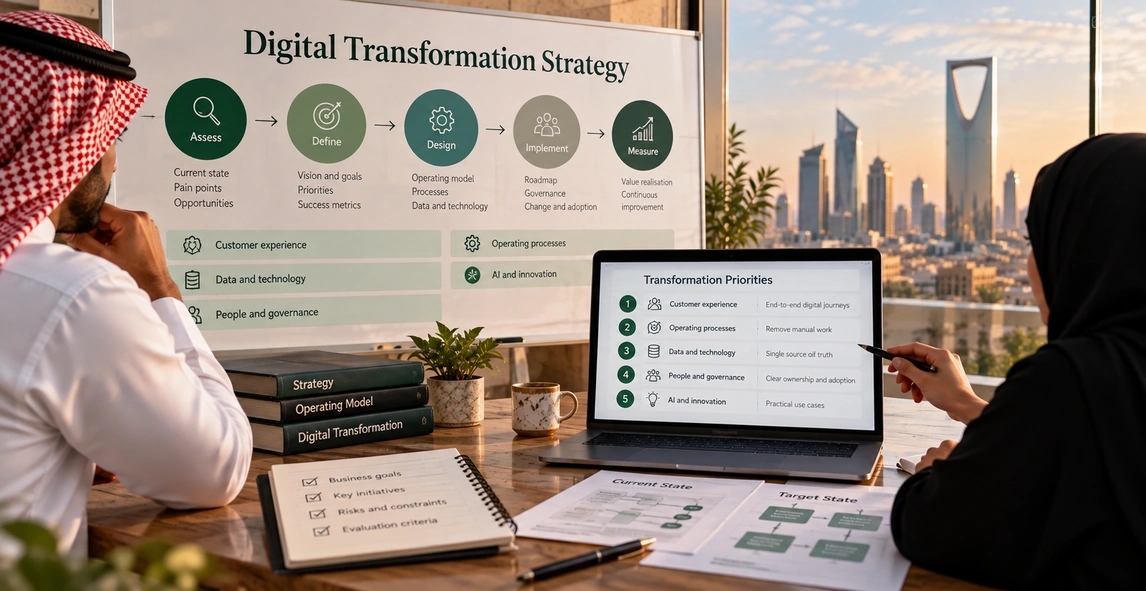
Digital Transformation Strategy Companies in Saudi Arabia: How to Choose
No published ranking names the best digital transformation strategy company in Saudi Arabia. Here are the criteria, cost drivers and questions that decide it.

Best Digital Operating Model Companies in Saudi Arabia: How to Choose
Why no one can rank the best digital operating model companies in Saudi Arabia, what these services cover, what moves the fee, and what to verify before you sign.
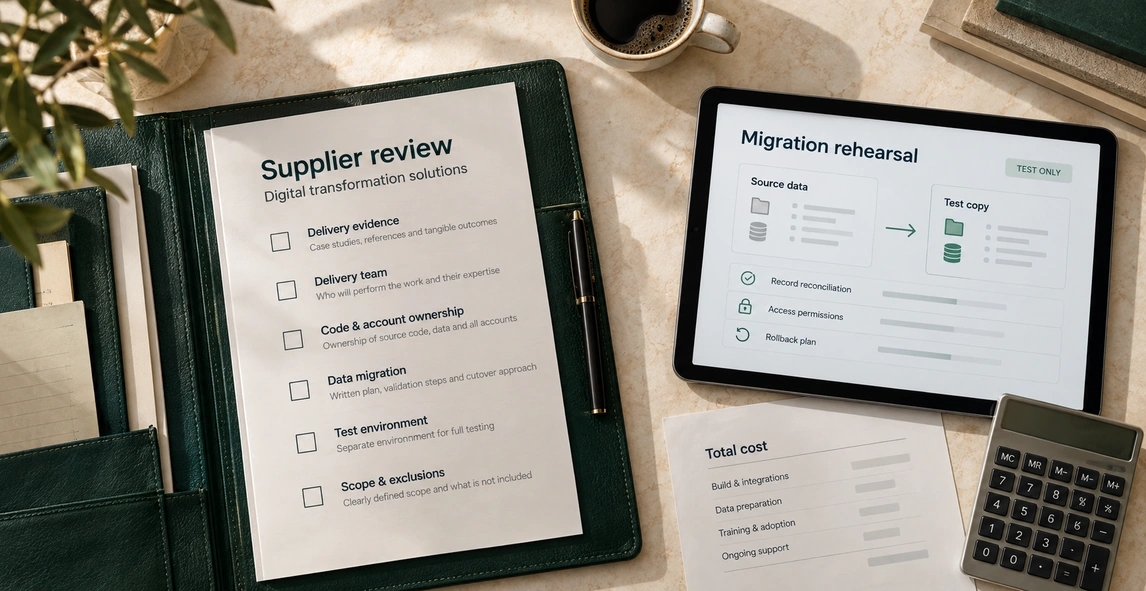
Digital Transformation Solutions Companies in Saudi Arabia
We name and rank no companies without verified evidence. This guide gives the criteria, the questions and the cost method you need to choose one yourself.

Digital Transformation Companies in Saudi Arabia: How to Choose One
No independent ranking settles which digital transformation company in Saudi Arabia is best. Here are the criteria and questions to decide for yourself.