
Best Digital Transformation Consulting Company in Saudi Arabia: How to Choose
Choosing the Best Digital Transformation Consulting Company in Saudi Arabia on Evidence You Can Verify
This guide covers what transformation is and is not, why it is pressing in the Kingdom, what these consultancies sell, how the work runs, the regulatory areas to confirm, how to evaluate a firm, why programmes stall, and how to measure the result. It publishes no prices, durations, ROI figures, market forecasts, failure rates, client names or testimonials, because we verified none of them; where a number is what you need, it says what determines it and how to get your own. Vision 2030, the giga-projects and national authorities are described as published programmes and named bodies to check with, nothing more.
Digital transformation changes how the work is done, not only which software runs it
Digital transformation means changing how a business creates and delivers value so that the work itself is done differently: processes redesigned, decisions moved to where the information is, and data flowing to the people who act on it. It matters for Saudi businesses for the ordinary reason it matters anywhere. Customers here already use banking and government services that complete online, and they apply that standard to everyone else; competitors entering the market build digital-first and carry none of your legacy cost.
What it is not is a purchase. Buying a platform changes what you own. Transformation changes what people do on Monday morning, which is why it costs more in attention than in licences and why it fails for organisational reasons far more often than technical ones.
Digitization converts a record; transformation redesigns the process
Digitization takes something that exists on paper or in someone’s head and puts it into a system: the form becomes a web form, the ledger becomes a database. The process itself is unchanged. Transformation asks whether the process should exist in that shape at all — whether the approval is needed, whether the customer should be asked for the same information twice, whether the step can be removed rather than automated. A programme that digitises without redesigning produces the familiar result: the same work, now on screens.
Four pillars, and the two that are usually underfunded
The core pillars are people, process, technology and data. Technology gets the budget because it can be procured. Process and people are where the change actually happens, and their cost is time rather than money — senior time, which is the scarcest input. Data sits underneath all three: if two systems count a customer differently, every report built on them is an argument rather than a fact. A plan that names all four pillars and allocates effort to one of them is a technology project with a transformation label on it.
The Saudi context explains the pressure, not the outcome
Transformation is pressing for companies in Saudi Arabia now because the comparison set has moved and because reporting and invoicing obligations increasingly assume systems rather than spreadsheets. Those are the reasons. Not the year on the calendar, and not a forecast — if a proposal argues from the date rather than from a constraint in your business, it is selling.
Vision 2030 shapes the environment; it does not predict your result
The Kingdom’s published programme for economic diversification is Vision 2030, and among its stated themes is the development of the digital economy. Its effect on any single company is indirect: it influences which sectors attract investment, which new entrants appear, and the level of digital service your customers have grown used to. Read any specific target in the official publications rather than in an article. We have verified no figures from it here, and a national programme is context, never evidence that your project will succeed.
Giga-projects and market forecasts
NEOM and the other announced giga-projects are large published development programmes. We have not verified any measured effect they have had on digital adoption in the wider economy, and we will not assert one. The defensible statement is narrower: programmes of that visibility raise expectations and create demand for suppliers who can integrate digitally, which matters to you mainly if you sell into them — in which case their own procurement documents are the source to read, not this page.
On how the Saudi digital transformation market is expected to grow by 2030, we could not verify a market-size or growth projection from a primary source, so this article publishes none. Such forecasts circulate widely with their methodology and date stripped away, and the spread between them is wide enough to support any conclusion you already hold. If a business case needs a figure, take it from the Kingdom’s own statistical publications or from a research report you have read in full, and quote it with its date and its assumptions attached.
Five sectors, and the different reason the work pays back in each
We will not rank industries by need, because we have not verified sector data that would support a ranking. The five below are the sectors where the mechanism is clearest. The test is the same in each: how much of the work could be completed by a system without a person in the middle, and what does regulation require you to be able to prove afterwards.
Government and public sector
Government and public sector entities need transformation because their obligation is service delivery to everyone, including bilingual parity, accessibility and a full audit trail — and manual processes fail those tests unevenly and invisibly. The binding constraints here are data residency, accessibility standards and procurement rules, all of which change scope and cost materially. Confirm the applicable standards with the commissioning entity before anything is designed.
Retail and e-commerce
Retail and e-commerce businesses in KSA need it because every manual step is a cost per order and every friction point is visible in abandoned baskets. The highest-return work is usually not the storefront but the integration behind it — stock, fulfilment, payment and accounting agreeing with one another — because that is where the errors and the labour actually sit.
Banking, finance and fintech
Banking, finance and fintech companies need it because product change, customer onboarding and regulatory reporting are all bounded by what their systems can do safely. This is the most heavily regulated category on this list, so the real constraint is auditability rather than technology. Confirm current requirements with the relevant financial authority before scoping; we have not verified the current text of any rule and this article states none.
Healthcare
Healthcare providers in Saudi Arabia need it for booking, records and the call volume that comes from having neither. Healthcare also carries the strictest constraints on patient data and on what may be said publicly about clinical outcomes. Confirm requirements with the relevant health authority before designing anything that touches patient information.
Manufacturing and logistics
Manufacturing and logistics companies need it for visibility: knowing where material is, what it costs to move, and where the delay occurs. The gain comes from capturing accurate data at each handover rather than from any single platform, which is why these programmes should start at the handovers and not at the dashboard.
What a digital transformation consultancy actually sells
A digital transformation consulting company is hired to decide what to change, in what order, and to make the change hold. What it delivers is judgement and sequencing, not software. If a firm’s answer to every problem is a platform it also implements, you are buying implementation with a strategy invoice attached.
The six services that make up most engagements
Most consultancies sell some combination of six things: a maturity assessment, a strategy and roadmap, technology selection, change management, customer experience and marketing transformation, and data, AI and automation work. You rarely need all six at once, and buying them as a bundle is how scope stops being arguable.
The digital maturity assessment
A digital maturity assessment is a structured inventory of where you actually are: which processes are manual, which systems exist and how they connect, what data you hold and whether it can be trusted, and what your people can operate today. You need one because without it a roadmap is a guess, and because a requirement found during assessment is cheap while the same requirement found during implementation is not. Its output should be a prioritised list with reasoning you can check, not a score out of five.
Strategy and roadmap
A strategy and roadmap should contain the business outcomes being pursued, the sequence of changes and the reason for that order, the dependencies between them, a named owner for each, the baseline each will be measured against, and the conditions under which the plan would be stopped or rewritten. A roadmap with dates but no owners and no stopping conditions is a wish list with a timeline.
Technology and software selection
Consultants help with selection by turning your process requirements into written evaluation criteria, running the comparison against them, and insisting on a trial with your own data rather than a vendor demonstration. The value sits in the criteria and in the exit terms — how you get your data out if the choice proves wrong — more than in the recommendation itself. Ask in writing what commercial relationship the consultancy has with any vendor it proposes.
Change management
Change management is the work of making sure the people whose jobs change can and will do the new version. It belongs inside transformation because the systems are usually the easier part: adoption is where programmes quietly fail, and software nobody uses still scores perfectly on availability. In practice it means involving the people who do the work in defining the problem before the tool is chosen, and being specific about what disappears from their day rather than only what is added.
Customer experience and marketing transformation
Here consultants work on the parts the customer touches: what they can complete unaided, how long it takes, and whether the Arabic version is as good as the English one rather than a translation of it. It sits inside transformation because a repaired internal process with an unchanged front end produces no visible result — and because the front end is where measurement is easiest and quickest.
Data, AI and automation
This work consolidates data that currently lives in disconnected systems, settles what each measure means, then removes repetitive steps and applies models where a task is high-volume and tolerant of review. The order matters. A model built on inconsistent data inherits the inconsistency and reports it confidently, and automating a process before simplifying it reproduces the same bad outcome faster and at higher cost.
A consultant, an IT company and a software vendor are paid for different things
A software vendor is paid for you to use its product. An IT company is paid to build or run what you specify. A consultant is paid to decide what should be specified, which includes being able to recommend that you build nothing. The practical test takes one question: who bears the consequence if the recommendation is wrong, and does the firm earn anything from the tools it recommends.
Four phases, and the output that should come out of each
Most consultancies run four phases. The names vary; the sequence rarely does. What matters is what each phase produces, because a phase with no checkable output is a billing period.
Discovery and assessment
Discovery is interviews, process walkthroughs, a systems and integrations inventory, and a look at real data rather than at how the data is described. The output is a prioritised set of findings with the evidence for each, the owner of each process, and an explicit list of what could not be established. Expect it to surface disagreements inside your own organisation about how the work is done; that is the phase doing its job.
Strategy and roadmap design
Here the findings are sequenced against business impact, risk and dependency, and the first piece of work is chosen — the smallest change that produces something usable and settles a real question. Baselines are recorded now, before anything changes, because after go-live no honest comparison can be reconstructed. This phase should also name what would cause the plan to change.
Implementation and execution
Implementation runs in stages, with the existing process available until the new one is proven. Parallel running costs more for a period and is often still the right choice, because it makes rollback real instead of theoretical. Agree the switch criteria in writing before migration begins, and expect your own review and decision time to be the item most often underestimated.
Monitoring, optimisation and scaling
After go-live the measures agreed at the start are compared against the recorded baseline, adoption is checked against actual system use rather than training attendance, and the change is extended to the next team or market only once it works in the first. Scaling a process that is not yet working simply distributes the problem.
Local knowledge is a specific, checkable advantage
The honest version of the local-versus-global question is not that one is better. It is that proximity changes specific things: who is in the room, how fast a misunderstanding is corrected, and whether Arabic is treated as a first language or a deliverable. Ask for those specifics rather than accepting the general claim — a global firm with a resident Riyadh team may be closer to you than a local firm subcontracting the work abroad.
What market knowledge actually changes
Local market knowledge affects the success of a programme in KSA mostly through assumptions nobody writes down: which payment and delivery expectations are normal, how customers prefer to make contact, what the working week does to a launch schedule, and which processes have a human relationship in the middle that a workflow diagram will not show. A partner who has to learn those from you is spending your budget on their education.
Understanding Saudi consumer behaviour matters because it determines where the friction is, and friction is what you are paying to remove. This does not require a statistic. It requires reading your own data — which channel your customers arrive from, where they abandon, what they call to ask — and a partner who asks to see that before proposing anything.
Arabic is a design constraint, not a translation task
Arabic-language and cultural localisation affects transformation at the level of the system, not the copy. Right-to-left layout, name and address formats, both calendars, search behaviour in Arabic, and content written natively rather than translated all change what is built. The common failure is an English-first product with an Arabic veneer: it works in a demonstration and falls apart in use. Ask to see an existing Arabic interface the firm built and use it yourself.
What a GCC-based firm can offer, stated carefully
A GCC-based consulting company can offer proximity, the same time zone, native Arabic, familiarity with regional regulators, and usually a shorter chain between the person you meet and the person who does the work. Those are structural advantages, not guarantees of quality, and an international firm may match any of them. Compare the firms in front of you on named staffing and checkable evidence instead of on their category.
Regulation: the areas to ask about and the authorities to confirm with
Saudi regulation affects transformation projects most often through where data may be held, how personal data may be used, what must be reportable, and what security controls are expected. We have not verified the current text of any of these rules, so this article names the areas and the authorities rather than stating requirements. Treat any consultant who recites regulatory detail from memory with more caution than one who tells you which authority to confirm it with.
SDAIA and national data and AI governance
SDAIA is the Kingdom’s national authority with responsibility for data and artificial intelligence, and it is associated with national data governance and AI policy. We have not verified its current guidance, frameworks or how they apply to a private company in your sector. Check directly with the Authority rather than relying on this summary or on a consultant’s account of it.
Data localisation and cybersecurity
Where data is permitted to be stored and processed is an architectural decision, not a later compliance step: it determines your hosting, your vendor shortlist and your integration design, and changing it after a build is expensive. Security expectations affect the same decisions. Establish the requirements that apply to your activity with the competent authority at the start of design, and keep the written answer.
What to expect a partner to understand
A digital transformation partner should be able to tell you which regulatory areas touch your project, which authority governs each, what evidence you would need to produce, and where they are not certain. What they should not do is assure you that a design is compliant without naming the source. Compliance responsibility stays with you; the partner’s job is to design so that demonstrating it is possible.
How to judge a consultancy on evidence rather than adjectives
When you are choosing a digital transformation consulting company in Saudi Arabia, almost every claim in a pitch is unfalsifiable. The useful criteria are the ones you can verify before signing: who will be on your project, what similar work they have done recently, what they earn from the tools they propose, and what the contract says when things go wrong. Send the same written brief to three firms, ask all of them the same questions, and compare answers rather than presentations.
Experience and track record
Evaluate track record by asking for the three most similar engagements from the last two years, with sector, scope, the constraint they were working inside, and a reference you may contact. A logo wall is not evidence: it does not say what was done, when, by whom, or whether it worked. Ask who from the named team was actually on those projects, since firms and people move.
On case studies and success stories, ask for ones that name the constraint and the sequence, not only the outcome, and ask for permission to speak to the client directly. The two questions worth putting to that client: what went wrong during the engagement, and how the firm behaved when it did. Ask to speak to a client whose engagement has ended, not only to current ones.
We will not publish a number of years to require, because years in business is a weak proxy and we have verified no benchmark for it. A firm five years old whose team has done your exact problem twice is a better bet than one fifteen years old with no relevant recent work. Ask instead how long the specific people assigned to you have worked in the Saudi market and on problems like yours.
Technical expertise
You establish technical expertise by asking about a decision, not a tool. Ask how they would decide between building and buying in your case, what they would do if the chosen platform could not handle a requirement found in month three, and what they would refuse to do. Then ask for a small, paid, scoped piece of work first — an assessment or a single integration — and judge the real thing rather than the proposal.
Which platform certifications a team should hold depends entirely on what you are building, so no general list is honest. Treat a certification as evidence that someone passed an exam on a product: useful, narrow, and no substitute for seeing work. What matters more is whether the certified individuals are the ones assigned to you, which you verify by having them named in the contract.
Ask plainly whether the work will be done by employees or subcontractors, who those subcontractors are, where they sit and who manages them. Subcontracting is not automatically a problem; undisclosed subcontracting is, because it decides who answers when something breaks. Get the staffing model written into the agreement.
Certifications and partnerships, read for what they are
Vendor partnerships indicate a commercial relationship and a training commitment. They are not independent assessments of quality, and a partner tier is awarded largely on sales volume, which is worth knowing when a partner recommends the product it sells. Organisational certifications such as quality or information-security standards tell you a process was audited, not that your project will go well. Verify any certification with the issuing body rather than accepting a logo, and ask every firm to disclose in writing what it earns from the tools it proposes.
Fees, return and the warning signs
Pricing and projected returns are areas where buyers may encounter numbers they cannot independently verify. The discipline is to evaluate the structure of the fee and the method of measurement rather than the headline figure, because the figure is a function of a scope that has not been fixed yet.
Why this article gives no budget range
We publish no budget range for digital transformation consulting in Saudi Arabia, because we have verified none and because any range wide enough to be true is useless for planning. What determines the fee is knowable: the scope and number of processes in play, how many systems must be integrated and how old they are, the state of your data, whether Arabic and English are both delivered natively, whether the team is resident, and how much of your own staff time the programme assumes. Ask each firm to price the same written scope, itemised, with the change-control clause attached — then you are comparing something real.
Measuring return without inventing one
You measure return on a transformation project the same way you would on any other investment, and it only works if you set it up before starting. Record the baseline for each measure you intend to move. Attach a value to the change: hours removed multiplied by the loaded cost of that time, error and rework rate, contact volume, cycle time, orders completed, cost to serve. Count the full cost, including your own people’s time and the run cost of whatever you now operate. We publish no ROI percentage and no payback period, and you should treat any supplier who offers one before seeing your data as guessing in a confident voice.
Warning signs worth walking away from
Avoid a consultancy that quotes a price before understanding your scope, promises a percentage improvement or a guaranteed outcome, cannot name the people who will do the work, will not disclose what it earns from the platforms it recommends, describes itself as the best or number one in the Kingdom without saying who measured that, presents anonymous testimonials in place of contactable references, or resists putting ownership of your code, data, domains and accounts in writing. Also treat complete agreement in the first meeting as a reason to ask for a more critical assessment.
Criteria to compare digital transformation consultants in Saudi Arabia
Use the same table for every firm on your shortlist. It deliberately asks what to request and what would count as proof, rather than inviting you to compare numbers that no one has verified.
|
Criterion |
What to ask for |
What counts as evidence |
|---|---|---|
|
Experience |
The three most similar engagements of the last two years, with sector and scope |
Named scope and a client you may call, not a logo wall |
|
Local presence |
Who is resident in the Kingdom, in which city, and how often they will be on site |
Named individuals and a staffing plan inside the contract |
|
Industry focus |
Which of your regulatory or operational constraints they have worked inside before |
The constraint described back to you accurately, unprompted |
|
Technology stack |
Which platforms they propose and what they earn from each |
A written disclosure of vendor commercial relationships |
|
Pricing model |
How the fee is structured — fixed scope, time, retainer — and what triggers a change |
An itemised price against your written scope plus a change-control clause |
|
Support and SLA |
What happens after go-live, who answers, and within what period |
Response and resolution commitments written into the agreement |
|
Client reviews |
Permission to speak to two clients, including one whose engagement has ended |
A conversation you arranged yourself, not a quotation supplied to you |
Where AY.SA fits, and what we will not claim about ourselves
We will not describe AY.SA as a leading or best digital transformation consulting company in Saudi Arabia. No independent body has ranked the firms in this market against published, measurable criteria, so the claim would be unsubstantiated. Choose us only if the fit is real, and this section is written to help you judge that rather than to persuade you.
What we will put in writing instead of a superlative
We will not characterise other agencies in the GCC, because we cannot verify how they work and it would not improve your decision. What we will commit to in a contract: the named people who will work on your project, your ownership of source code, cloud accounts, domains and analytics, written acceptance criteria, disclosure of any commercial relationship with a platform we recommend, and Arabic produced natively rather than translated. Ask every firm on your shortlist for the same commitments and compare the answers.
The services we offer, described plainly
Our work covers digital and search strategy, SEO and content in Arabic and English, digital marketing, web and platform development, branding, and the assessment and prioritisation work that decides which of those is worth doing first. Scope for any engagement is agreed in writing before work begins, and we publish no fixed packages or fees, because the scope is what the fee depends on.
These sit under one roof in a specific, practical sense: the same team defines the positioning, builds the pages, writes the Arabic and English content and reports on what happened, so a decision made in strategy is not lost in a handover between suppliers. The trade-off is real and worth stating — a single supplier is simpler to hold to account and gives you fewer independent opinions. If you want a second opinion on our recommendation, get one.
Results, case studies and testimonials
This article publishes no client results, no named clients and no performance figures for work we have done. We hold no verified, client-approved set of numbers we can put on a public page, and quoting unverifiable outcomes would contradict everything above. If you are evaluating us, ask in a meeting for relevant recent work and for a reference you can contact, and hold us to the same standard this guide asks you to hold everyone else to.
For the same reason there are no case studies here showing our impact on client growth. A case study is only evidence if it names the starting point, the intervention, the measurement method and the period — and if the client agrees to be asked about it. We would rather give you one of those in a conversation than a page of unattributed graphs.
There are no testimonials on this page either. An anonymous quotation is unfalsifiable by design, and a favourable one selected by the supplier tells you only that at least one client was happy. A contactable reference is worth more than any number of quotations, so that is what we will offer you.
How the work is adapted to Saudi and GCC markets
Adaptation for us means Arabic written natively rather than translated, content and search work built on how people actually search in Arabic in each market, market-specific integrations and payment and delivery expectations, and one platform with one reporting line so that markets can be compared. Which markets are in scope, and who covers them, is agreed in writing before work starts.
Why these programmes stall, and the causes you can act on
Several major challenges companies face during transformation in Saudi Arabia are organizational rather than technical: scope that keeps growing, leadership attention arriving only at launch, data-quality problems discovered late, employees whose roles change without consultation, and early technology decisions made without documented reasoning.
On the claim that most projects fail
A figure for transformation failure rates is repeated everywhere and we could not verify one from a primary source, so we will not repeat it — and the figures that circulate usually do not define what counts as failure. What is observable without a statistic is that the same three causes recur, and all three are organisational.
Resistance to change
Resistance affects outcomes because adoption, not deployment, is what produces the result: a system in production that people work around has changed your cost base for the worse. Resistance is also usually information — the people doing the work know why the old step exists. Treat it as a design input rather than a communications problem, involve those people before the tool is chosen, and be explicit about what leaves their day.
Absent leadership
Lack of leadership buy-in derails programmes because transformation requires decisions that cross departments — who owns a process, whose budget carries a shared cost, which team stops doing something. Without a senior owner able to settle those, the programme defaults to the changes that need nobody’s permission, which are the ones that change nothing. Sponsorship means available decision time on a schedule, not a quotation in the launch deck.
The wrong technology stack
A wrong stack hurts long-term because the cost appears later: integrations that need custom work every time, a licence model that punishes the growth you were planning, a skills base you cannot hire locally, and data you cannot get out. Reduce the risk by testing with your own data before committing, and by negotiating exit and data-export terms while you still have leverage.
Where a consultant genuinely helps
A good consultant helps by insisting on a baseline and a stopping condition, documenting cross-departmental decisions and deadlines, applying lessons from similar projects, and raising issues that internal staff may find difficult to surface. However, a consultant cannot replace executive sponsorship or make decisions that leadership avoids.
Skills gaps, stated without a statistic
We have not verified labour-market data on skills shortages in the Kingdom and will publish no figures. The gap you can check is your own: list the systems you will operate after the change and name the person who will run each one. Where there is no name, you have found the gap. Consultants help by building the capability rather than the dependency — pair delivery with your staff, insist on written handover and runbooks, and make knowledge transfer an acceptance criterion rather than a final-phase promise.
What is changing now, and which of it should change your plan
Trends matter only where they change a decision you are about to take. Six are doing that in the Saudi market at the moment; none of them justifies restarting a plan that is already working.
Artificial intelligence
AI is reshaping strategies in KSA mainly by changing the order of work: data consolidation and governance moved from a later phase to a precondition, because anything useful depends on data a model can rely on. It has not replaced the strategy question, which is still which constraint you are removing. Where AI helps is a repetitive, high-volume task whose output can be reviewed.
On how Saudi companies are using generative and agentic AI, we have verified no adoption survey and will publish no percentages. What is technically available and in use generally is well enough understood to describe: generative models for drafting, summarising, translating and classifying text, and agentic systems that chain several steps and call other systems, which raises the value and the review burden together. Before funding either, ask what happens when it is wrong, who notices, and how quickly it can be switched off.
The Kingdom has a published national commitment to artificial intelligence, with SDAIA as the responsible national authority. We have verified no investment figure, target or programme outcome and state none. For a business, the effects that matter are indirect and second-hand — local availability of infrastructure and skills, and rising customer expectations — and none of them is a reason to buy anything on its own.
Cloud, cybersecurity, commerce and automation
Cloud adoption across Saudi enterprises is accelerating in the sense that regional infrastructure and managed services have made it the default for new systems rather than an exception to justify. We publish no adoption rate. The decision it changes for you is architectural: cloud makes capacity a setting rather than a purchase, and makes cost consumption-based, which grows quietly with careless design. Budget for cost management, not just migration.
Cybersecurity has become part of transformation strategy rather than a review at the end because the changes themselves create the exposure: more integrations, more identities, more data in more places. The practical consequence is that access control, logging, patching and backup belong in the design of each phase, and that where data is allowed to live is decided before architecture, not after.
E-commerce and omnichannel strategies in the Saudi market are evolving toward the customer expecting one account, one stock position and one service history across app, site, store and messaging. That is an integration problem rather than a channel problem, which is why it is usually solved behind the storefront. Measure it where it shows: whether a customer can start in one channel and finish in another without repeating themselves.
Automation is changing operations mainly by moving the human role from doing the step to handling the exception. That is a genuine shift in how a team is organised and staffed, and it fails in a predictable way — automating a process nobody simplified first. The order is: remove the step, then simplify what remains, then automate it.
Measurement only works against a baseline you record first
You measure the success of a transformation project against a baseline recorded before anything changed, using measures agreed in advance, with the full cost counted. Without the baseline there is no honest comparison afterwards, whatever the closing report contains — and the baseline is free while the work has not started and impossible to reconstruct once it has.
What to track, and when
Before the work, record the current value of each measure and how it was calculated, so nobody can redefine it later. During the work, track a small number of leading indicators — adoption of the new process, error and rework rate, throughput — because they tell you whether to continue. After go-live, compare against the baseline on a fixed schedule, and keep measuring long enough to see whether the change held once the project team left.
For customer experience, the measures worth tracking are the ones your customers act out: completion rate at the step where they currently abandon, time to complete the task, contact volume and what those contacts are about, resolution time, repeat contact for the same issue, and satisfaction collected at the moment of the interaction rather than in a quarterly survey.
For operational efficiency, track manual hours spent on the affected processes, cycle time from start to finish, error and rework rate, exception volume, system availability, and cost to serve one unit of work. Hours and rework are the two most people can measure immediately from records they already hold.
For revenue and growth, track the measures you can attribute honestly: orders or applications completed, conversion rate at the step you changed, average order or contract value, retention and repeat purchase, pipeline created by channel, and customer acquisition cost. Be careful about attribution — several things usually change at once, and a claim that one project caused a revenue movement needs more than coincidence in time.
On how soon results appear
We will not publish a timeline, because we have verified none and because the honest answer depends on what you changed. What determines it is knowable: how narrow the first change is, how much volume flows through the affected process, how quickly people adopt it, and whether you were already measuring. A useful rule when scoping is to choose a first piece of work small enough that its effect would be visible in data you already collect — and to write down, before starting, what result would count as success and what would cause you to stop.
How to start, and what to ask in the first conversation
Start a transformation with the smallest paid piece of work that settles a real question, not with a programme plan. An assessment you can act on is worth more than a roadmap nobody has tested, and it also tells you how the firm behaves when the work is real.
The step to take before you contact anyone
Before contacting a consultant, write down the constraint in one page: the process that is failing, what it costs you now in hours or lost orders, the systems involved, who owns it, and what you would accept as a result. Record the current numbers. Doing this yourself costs nothing, makes every proposal comparable, and immediately distinguishes the firms that engage with your page from the firms that reply with their own.
Questions for the first consultation
Ask who exactly will do the work and whether they are employees. Ask which similar engagement is closest to yours and whether you may speak to that client. Ask what they earn from any platform they recommend. Ask what they would need to see in your data before committing to an approach, and what they would refuse to do. Ask what the smallest useful first engagement would be, and what its written deliverable is. Ask who owns the code, data, accounts and domains, and what happens if you stop. Then notice whether the firm is willing to challenge any assumption; complete agreement may warrant a more critical follow-up.
How to approach AY.SA
We do not advertise a standing free assessment or consultation, and this page will not promise one on our behalf. What we do is talk through the one-page constraint above at no charge, tell you whether we are a sensible fit, and say so plainly when we are not; anything beyond that is scoped and quoted in writing first. Send the page to us through the contact route on this site, and ask the same questions of at least two other firms before you decide.
0 Comments
No comments yet. Be the first to comment!
Related Blogs

Best Digital Modernization Company in Saudi Arabia: How to Choose One
Why nobody can rank the best digital modernization company in Saudi Arabia, what these firms actually do, what moves the cost, and what to verify before you sign.
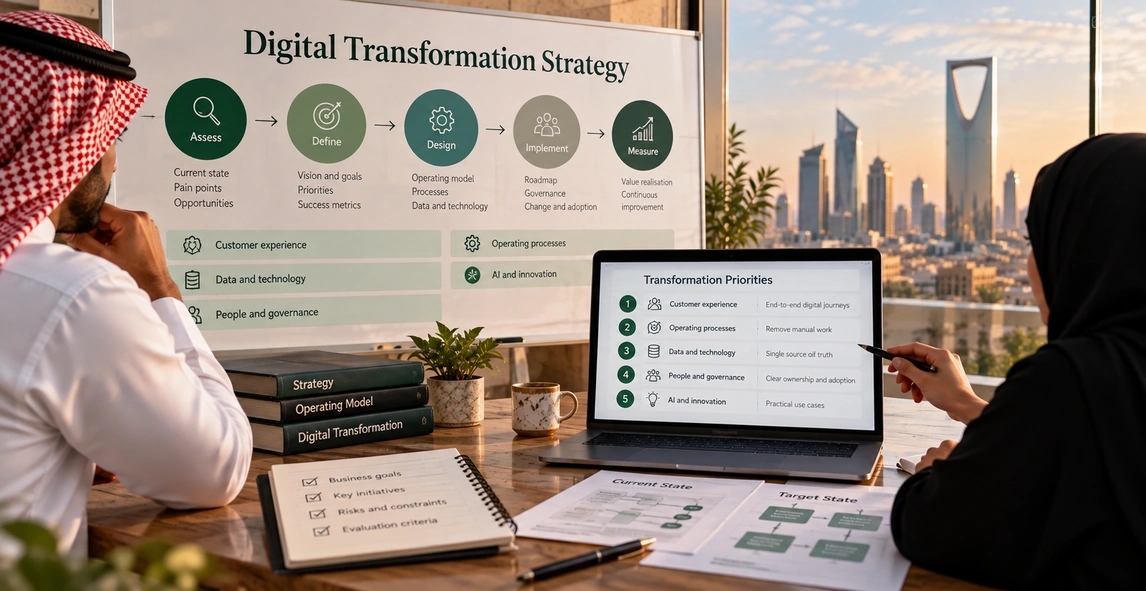
Digital Transformation Strategy Companies in Saudi Arabia: How to Choose
No published ranking names the best digital transformation strategy company in Saudi Arabia. Here are the criteria, cost drivers and questions that decide it.

Best Digital Operating Model Companies in Saudi Arabia: How to Choose
Why no one can rank the best digital operating model companies in Saudi Arabia, what these services cover, what moves the fee, and what to verify before you sign.

Digital Transformation Services Companies in Saudi Arabia: How to Choose
What digital transformation services companies in Saudi Arabia do, why we publish no ranking, what drives the cost, and how to verify a provider before signing.
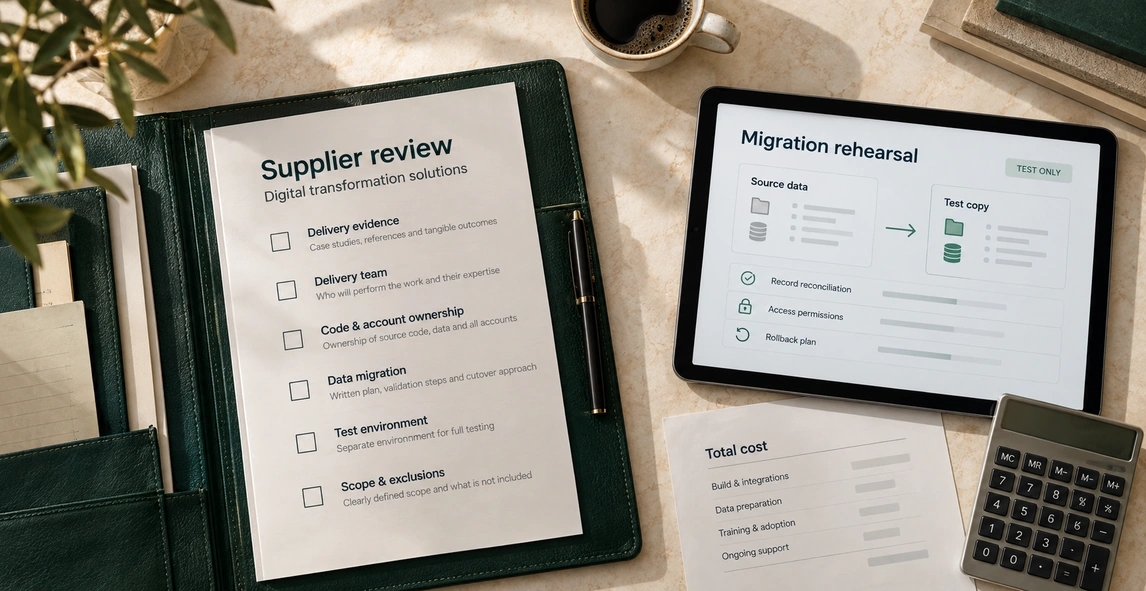
Digital Transformation Solutions Companies in Saudi Arabia
We name and rank no companies without verified evidence. This guide gives the criteria, the questions and the cost method you need to choose one yourself.

Digital Transformation Companies in Saudi Arabia: How to Choose One
No independent ranking settles which digital transformation company in Saudi Arabia is best. Here are the criteria and questions to decide for yourself.