
Best Digital Modernization Company in Saudi Arabia: How to Choose One
Best Digital Modernization Company in Saudi Arabia: Choosing One on Evidence You Can Verify
This guide covers what digital modernization is, what the Saudi and GCC context does and does not prove, the criteria that survive scrutiny, the service lines on offer, what moves the cost, where these projects fail, and how to run a shortlist. It publishes no ranking, no prices, no durations, no ROI figures and no client results, because we have verified none of those; where a number is what you need, it says what determines it and how to get your own. Vision 2030, NEOM and the Kingdom’s authorities are described as published programmes and named bodies to check with, nothing more.
Digital modernization rebuilds the systems you already run
Digital modernization means rebuilding the systems, data and processes a business already depends on, so they run on current technology and can be maintained, integrated and changed. Its starting point is what exists. That is what separates it from buying new software, and it is why the state of your own estate matters more than the year.
The reason it matters now is a cost curve rather than a calendar. Software that no longer receives updates may carry vulnerabilities without reliable vendor patches, and the pool of people who can safely change an old system shrinks every year. Both get worse quietly until something forces the issue.
Modernization changes how the work is done; transformation changes what the business does
Modernization keeps the business model and rebuilds the machinery: same products, same customers, systems that can be changed. Transformation changes what you sell, to whom, or through which model. Modernization is often a precondition for transformation but not a substitute for it. Confusing the two produces the familiar result — newer systems performing exactly the old work.
Four pillars, and the two that get skipped
In practice there are four: the infrastructure systems run on, the applications themselves, the data they produce, and the processes and people around them. A programme that addresses only the first two ships a technically current system that nobody works differently around. Budget the last two explicitly or they disappear.
Cloud migration removes the hardware constraint and turns capacity into a setting rather than a purchase, which is what makes rebuilding a system in pieces possible. It is not automatically cheaper: costs are consumption-based and grow with careless architecture. Treat it as flexibility bought, with a cost model that needs active management.
Artificial intelligence contributes at the edges of a process — classification, extraction, drafting, forecasting, first-line support. It pays where a task is repetitive, high in volume and tolerant of review. It is not a modernization strategy; a model added on top of a broken process automates the breakage at speed.
Cybersecurity is the pillar that makes the rest defensible: identity and access control, least privilege, encryption, patching, logging and tested backups, designed in rather than bolted on. Retrofitted security is both weaker and more expensive, which is why it belongs in acceptance criteria rather than in a later phase.
When modernization stops being optional
It stops being optional at a measurable point: when maintaining what exists costs more than replacing it, when the existing systems cap something the business needs to do, or when too few people are left who can change them safely. If none of those applies to you, modernization is not urgent, whatever year is printed on the brochure.
The Saudi and GCC context, and what it does not prove about your project
We have not verified data comparing digital modernization activity across GCC countries, so this article does not claim that Saudi Arabia leads the region. The checkable facts are narrower: the Kingdom is the largest economy in the GCC, it runs a published national diversification programme, and much of its public service delivery has moved online. Treat leadership claims — including that one — as claims.
Vision 2030 is context, not evidence
Vision 2030 is the Kingdom’s published economic diversification programme, with digital economy development among its stated themes. Its effect on an individual business is indirect: it shapes which sectors grow, which competitors appear, and the standard of digital service your customers compare you against. Verify any specific target in the official publications before citing it, and never treat it as evidence that a project will succeed.
Sector investment: no ranking, but a reliable pattern
We have not identified verified investment data by sector and will not rank sectors. The structural pattern is more useful anyway: modernization funding follows transactability and regulatory pressure. Where the customer transaction can complete online, or where reporting obligations are heavy, this work gets paid for earliest.
In retail, the visible modernization sits at the join between channels — stock, pricing, fulfilment and returns behaving the same way online and in store. The highest-return work is usually integration rather than the storefront, because every unjoined system eventually shows up as a cancelled order.
In healthcare, it is booking, records and the call volume that a working self-service channel removes. Healthcare also carries the strictest constraints on patient data and on what may be claimed publicly, so confirm current requirements with the relevant health authority before scoping anything that touches patient information.
In the government sector, the driver is service delivery, accessibility and bilingual parity rather than commercial conversion. These programmes carry specific accessibility, data-residency and procurement requirements that change scope and cost materially — confirm the applicable standards with the commissioning entity rather than assuming them.
Giga-projects raise expectations; that is not a measured effect
NEOM and the other announced giga-projects are large published development programmes. We have not verified any measured effect they have had on modernization practice in the wider economy, and we will not assert one. The honest framing is that flagship programmes raise visibility and expectations, and that they compete for scarce technical people — an inference, not a finding.
Criteria that define a good company, in place of a ranking nobody publishes
Nobody can hand you the best digital modernization company in Saudi Arabia, because no independent body collects comparable performance data on these firms. What can be defined is a set of criteria you apply yourself, each of them checkable before money moves.
- Named people who will do the work, with their availability stated — not a company capability deck.
- Comparable delivered work you can inspect, with the baseline and this provider’s own contribution identified.
- A written method: stages, deliverables, acceptance criteria and explicit exclusions.
- Ownership terms in your favour — source code, repositories, cloud, domain, analytics and advertising accounts in your name.
- A migration and rollback plan, because that is where these projects fail.
- Support terms after go-live with response times, not goodwill.
- A reference call with a client you picked from a list, rather than one selected for you.
Weight what you can verify before signing above anything you cannot. That rule helps separate verifiable evidence from sales language.
Local market experience matters for specific things, not everything
Local experience in the Kingdom and the wider GCC matters where the work touches language, local integrations and regulatory process: Arabic written natively rather than translated, national payment and identity integrations, familiarity with approval and procurement timelines. For general engineering quality it matters little. Ask which named person delivered which local integration, and in which language.
Certifications are a floor, not a differentiator
Cloud and platform certifications show that individuals passed exams and that a firm met a partner threshold. They are useful as a floor and weak as a differentiator. Two questions make them informative: who holds the certification, and will that person work on your account. Where you carry regulatory obligations, management-system certifications for information security and quality carry more weight. We make no certification or partnership claims about ourselves anywhere in this article.
Reading a portfolio without being sold to
Read every case study with three questions: what the baseline was, what this provider itself changed, and what else changed at the same time. A percentage with no starting point is decoration. Then ask whether the client approved publication and whether you may speak to them, because an unverifiable result is not evidence.
Before you open a case study, agree what would count as proof: which measure, over what period, compared with what. Then ask who the client was and whether they will confirm it, which parts of the work this provider did and who else was involved, what the situation was before, what was actually delivered, what went wrong, and whether the same team is available to you. Set those questions first and the document becomes evidence rather than a story.
Why a mixed team beats a single specialism
Modernization spans systems, data, process and the people who use them, so a team of one specialism solves the part it recognises and leaves the rest. The practical test is whether the provider can name someone accountable for process change and training, not only for the build. Where that person does not exist, the new system lands and the old workarounds survive.
The service lines, and the constraint each one removes
The companies selling this work in the Kingdom usually offer four service lines: marketing modernization, technology and infrastructure modernization, customer experience, and data and analytics. Buying all four at once is the common and expensive mistake. The useful question is which one removes the constraint you actually have.
Marketing modernization
Marketing modernization covers the systems and content that bring demand in: a site that is fast and indexable in both languages, search and campaign work built on measurable intent, analytics and consent configured so the numbers are trustworthy, and a CRM joined to it so a lead is one record from click to close. It is the right starting point when demand is the constraint and delivery is not.
Search work belongs in modernization because most of what improves it is technical and structural: information architecture, crawlability, page performance, Arabic and English handled as first-class versions rather than one translated from the other, and content that answers what buyers actually type. Those are modernization tasks that happen to produce search results.
Paid media belongs there as the fast, controllable half of the same system. It buys attention immediately, which makes it a quick way to test whether a message, an offer or a landing page works before you rebuild anything on that assumption. It stops paying when it substitutes for the fix: budget spent sending traffic to a page that cannot convert is a recurring cost with no asset at the end.
Social media management belongs where your audience researches and asks questions in public, and where responsiveness is part of the product. Treat it as a channel with owned content behind it, so the asset survives a platform change. Its measurable contribution is reach into a defined audience and the assisted conversion path, not follower counts.
Technology and infrastructure modernization
This line covers the systems the business runs on: infrastructure, core applications, the integrations between them, and the security around them. It is the right starting point when delivery, reliability or the cost of change is the constraint, and it is the line where migration planning decides the outcome.
Cloud infrastructure modernization moves systems onto managed infrastructure, or rebuilds them to use it properly. A lift-and-shift migration is quick and inherits the old design; a cloud-native rebuild uses managed services and scaling and costs more up front. Which is right depends on how long the system will live and how often it must change.
Legacy system modernization deals with a system the business depends on but can no longer change safely. The decision that matters is the route — rehost it, refactor it, rebuild it, or replace it with a product — because each carries a different cost, risk and reversibility. Choosing between those four with evidence is the real work.
Customer experience modernization
Customer experience modernization rebuilds the parts customers touch: self-service, booking, ordering, status, payment and support, in the language the customer uses. The measurable effect usually appears as a fall in contact volume and in abandonment at one specific step, both visible in your own records within weeks rather than quarters.
Data and analytics modernization
Data and analytics modernization consolidates data that currently sits in disconnected systems, settles what each measure means, and makes reporting reliable enough to act on. Most reporting disputes are definitional rather than technical — two systems counting a customer differently — and this work forces those definitions to be agreed. It has to precede serious AI work, because a model built on inconsistent data restates the inconsistency confidently.
How AY.SA works, stated as commitments rather than claims
We will not call ourselves a leading digital modernization company in Saudi Arabia. Nobody can verify a claim like that, ourselves included, and this article has just argued that such claims are the first thing to discount. What we can do is state what we work on and what we put in writing, so you can hold us to the same checklist you apply to everyone else.
What goes in the contract
- Named people on your project, with their availability stated.
- Your ownership of source code, repositories, cloud accounts, domain, analytics and advertising accounts.
- Written acceptance criteria for each stage, with payment tied to acceptance.
- A first stage small enough that stopping after it costs you little.
- Arabic written natively, not translated.
- What support covers after go-live, and the response times.
We will not characterise competitors. We cannot verify how other firms work, and a comparison we wrote about ourselves would not help your decision. Ask every provider on your shortlist for those six items in writing and compare the answers rather than the adjectives.
Industries and markets: a question of fact, answered in writing
We do not publish a list of industries or GCC markets we serve as a capability claim, because broad footprint claims can be difficult for a buyer to verify. Ask the specific version instead — which named person has delivered in your sector and your market, in which language, with which local integrations — and we will answer it in writing and put the covered markets in the contract.
The process: audit, roadmap, staged delivery
Our modernization work runs as an audit, then a roadmap, then delivery in stages with measurement after each release. Each stage produces something you own whether or not you continue with us.
The audit is an inventory rather than a diagram: systems, integrations, data and manual processes, with the owner and the risk for each, plus a baseline for the measures you care about. Its output is a prioritised list with reasoning you can check. A requirement found here is cheap; the same one found during implementation is not.
The roadmap sequences that inventory against business impact and risk, then names the smallest first step that delivers something usable. It states what is excluded, what would cause us to stop, and what each stage costs to run afterwards. A roadmap that does not name the first priority is incomplete.
Measurement is against the baseline recorded before the work started, on measures agreed in advance: one business outcome, the diagnostics that explain it, and adoption alongside them — because a system nobody uses scores perfectly on availability and delivers nothing. Without that baseline no honest comparison exists afterwards, whatever a final report contains.
Cost and return: what moves the number, and how to calculate your own
We publish no prices, price ranges or day rates for digital modernization in the Kingdom. We have verified none, and an invented band would anchor your budget on nothing. What follows is what moves a quote, which is enough to read one critically and to tell a scoped estimate from a guess.
What moves a quote
- The condition and documentation of the systems you already run.
- How much data must be migrated, and how clean it is.
- The number and complexity of integrations, and who owns each one.
- Whether old and new must run in parallel at cutover.
- Security, accessibility and regulatory requirements you have to prove.
- How much process redesign and training is in scope, and who owns it.
- The seniority of the named people, and whether any work is subcontracted.
- What it costs to run afterwards — hosting, licences, support.
Ask any provider which of those they assumed, and what happens to the fee when an assumption turns out to be wrong. A quote that cannot answer that may be based on incomplete assumptions.
Calculating return without borrowing anyone else’s figure
We have not verified an ROI figure or a payback period and will not publish one you would plan against. Calculate it directly: the recurring cost you remove each month — manual hours at their loaded cost, licence and hosting spend, error and rework — against the total cost of the change including what it costs to run. That produces a crossover point specific to you, which is the most relevant basis for your planning. Record the baseline before you start, or the calculation is unavailable later.
Gradual and all at once are a risk decision, not a price decision
Staged work usually costs more in total and less in risk, because each stage repeats some setup and testing. A single large cutover looks cheaper on paper and concentrates every unknown into one weekend. The decision rule is coupling: systems that must change together should change together, and everything else should be sequenced so that a failure is recoverable. For most businesses that means staged delivery, funded stage by stage on the evidence each stage produces.
What the wrong provider costs, and the signals that come first
Problems with provider selection may not be visible at the start. Warning signs include a build that drifts from the brief, a launch that does not replace the old process, and a maintenance arrangement that is difficult to exit. Fees and timelines may sometimes be recoverable, but unreliable migrated data and accounts held in someone else’s name can create lasting damage.
The mistakes that happen on your own side
- Starting from technology instead of the constraint you are trying to remove.
- Automating a process before simplifying it, which reproduces the same bad outcome faster.
- Scoping the programme as a technology project, so process change and training have no budget or owner.
- Skipping the baseline, which makes any later claim of improvement unarguable in both directions.
- Migrating data without profiling it first, then finding the errors in production.
- Funding the whole programme up front on estimates nobody can support at that stage.
- Leaving nobody internally accountable, so decisions wait and the supplier fills the gap.
Avoiding vendor lock-in
Lock-in is created by ownership and by design, and both are negotiable before you sign. Put source code, repositories, cloud accounts, domain, analytics and advertising accounts in your own name from the start. Prefer standard components over a provider’s private framework, and require documentation and a runbook as deliverables rather than afterthoughts. Then ask what an exit looks like in practice: what you receive, in what format, and how long a handover takes. Test it cheaply by asking for a mid-project handover package and seeing whether it arrives.
Signals worth walking away from
- Guaranteed outcomes: rankings, conversion lifts, ROI or a fixed payback period.
- A ranking or award used as the main credential, with no criteria published.
- Certifications or partnerships asserted but not named, dated, or attributable to someone on your team.
- Case studies with percentages and no baseline, and no client you may contact.
- A fixed price offered before any discovery, or a fee with no stated assumptions.
- Accounts, code or data held in the provider’s name.
- No named people, or names that change after signature.
- Reluctance to put acceptance criteria, rollback or support response times in writing.
GCC coverage, and what actually differs between these markets
Many companies state that they cover the whole GCC. Treat it as a question of fact rather than a claim to accept or reject: ask which named person has delivered in each market, in which language, and which local integrations and regulatory processes they handled. Then put the covered markets in the contract. We make no regional footprint claim about ourselves here, and we nominate no company as the best.
What differs across these markets, and what does not
The engineering barely changes between them. What changes is the layer around it: language and dialect in customer-facing content, payment and identity integrations, data-protection rules and where data may be stored, procurement and approval processes, and the mix of devices and platforms your customers actually use. Those differences are enough to invalidate a copied launch plan and small enough to handle on shared infrastructure.
For the UAE we have not verified current market data and will not characterise trends. What is checkable is structural: it is a distinct regulatory jurisdiction with its own data-protection regime and its own government digital services, in a strongly bilingual commercial market. Verify the applicable rules with the competent authority there before scoping.
For Qatar the same applies — we publish no trend claims we cannot source. Treat it as a separate jurisdiction with its own authority for data and digital government, and confirm hosting and data-transfer requirements directly before designing anything that stores personal data.
Bahrain, Kuwait and Oman are three separate markets, grouped here only because we have verified no comparative data for any of them. Each has its own regulator, its own government digital programme and its own payment landscape. Anyone offering you a single trend statement covering all three is generalising.
Why a Saudi-based partner is often the practical choice
We have not surveyed GCC businesses on this and will not claim that a preference exists. The practical arguments are there for you to weigh: a team in the same time zone with an overlapping working week, Arabic written natively, familiarity with Saudi payment, identity and government integrations, and a legal entity you can contract with locally. Weigh them against the counter-argument — that knowledge of markets outside the Kingdom may be thinner — and ask for named evidence either way.
Trends worth acting on, and the ones we will not assert
A trend is only useful if it changes a decision in front of you. We publish no adoption statistics or forecasts for this market. What follows is limited to mechanisms you can act on, and it says plainly where we have nothing to offer.
AI in marketing shifts the work, not the principle
The mechanism is cheaper production and faster testing: variants, audience models and bid decisions handled by systems rather than by hand. The consequence is that the scarce inputs become judgement, data quality, and brand-level decisions about what to say. As a buyer, ask what a provider automates, what a human reviews, and how a wrong automated decision is detected — not how much AI they use.
Generative AI changes the cost of content, so it changes what wins
When producing text is cheap, volume stops being a differentiator and verifiable specificity becomes one: your own data, your own examples, and claims a reader can check. Practically, that means editorial review and a source standard matter more than output rate. Ask how assisted content is reviewed, who is accountable for a wrong statement, and make accuracy part of acceptance rather than a hope.
Automation pays where a process crosses several systems
The useful form combines integration, workflow and decision rules across a whole process instead of automating single tasks. Screen-level automation that drives an old interface is a bridge rather than a destination, because it breaks when the screen changes. The precondition is unchanged: simplify the process first, or you scale the mess.
Data-protection rules are a design input, and need checking at source
The Kingdom has a personal data protection regime and a national authority responsible for data and artificial intelligence, and other GCC states have their own. We have not verified the current text of any of those rules for this article and will not summarise them as settled requirements. Treat this as a design input: decide early what personal data you collect, where it is stored, who can reach it and how long you keep it, then confirm the current obligations with the competent authority or your own legal advisers.
A selection process you can run in about two weeks
Choosing well is procedural rather than intuitive. Shortlist three or four companies, give each the same one-page brief describing your constraint, your systems and the decision you need, and compare them on the same dimensions in the same order.
- The people: named individuals, their availability, and whether any work is subcontracted.
- The method: stages, deliverables, acceptance criteria and explicit exclusions.
- The artefacts: a sample of real work — an audit note, a migration plan, a test report — redacted if necessary.
- The commercial terms: ownership, exit, support, and what happens if you stop after the first stage.
- A reference call with a client you picked from a list.
- A small paid first stage, bought from the two strongest and judged on the work rather than the pitch.
That last step is the only one that produces evidence instead of a claim, and it costs far less than the wrong long engagement.
Questions for the discovery call
- Who does the work, and what else are they assigned to during our project?
- What is delivered at each stage, and what is explicitly excluded?
- Do we receive source code, repository access and documentation, and are the cloud, analytics and advertising accounts in our name?
- How will data be migrated, and how will we verify that it is correct?
- What is the rollback plan, and what are the cutover criteria?
- What does support cover after go-live, and what are the response times?
- Tell us about a project that went wrong, and what changed afterwards.
- What do you need from us, and how much of our own time does this require?
Listen for two things: whether the answers are specific, and whether anyone says no. A provider who accepts every requirement without qualification has not read the brief.
Comparing proposals without comparing incomparable things
Proposals rarely arrive in the same shape, so normalise them before judging: the same stages, the same assumptions and the same exclusions listed side by side, with run costs after go-live included. Then compare how many systems and integrations each provider assumed, the seniority of the people named, and how much of your own time each plan requires. A cheaper proposal that excludes migration, training or support is usually the expensive one.
What a strong service level agreement contains
A usable SLA states what is covered, response and resolution targets by severity, the hours those targets apply in, how an incident is raised and escalated, what reporting you receive, what is excluded, and what happens when a target is missed. Ask for the provider’s own performance against the same targets for the last three months; a firm that measures itself can produce it.
Why this article publishes no client results
We do not have verified published client results for this service and will not invent any, so this section answers a different question: what a success story would have to contain before it told you anything. The outline for this article asked for e-commerce and B2B results in the Kingdom. We have verified none, so none appear here.
What a case study needs before it counts as evidence
- A named client who confirms the account, or a reference call you may take.
- A baseline recorded before the work, with the measure and the period stated.
- A clear statement of what this provider did, and who else contributed.
- What else changed at the same time — a price change, a new competitor, a seasonal peak.
- What went wrong during the project, and what correcting it cost.
- A date, because a result achieved on an older stack may not transfer.
A percentage without a baseline is decoration, and a result with no contactable client is a story. Apply that test to every provider, including us.
What you can verify for yourself instead
Two things are free. Look at what comparable businesses in your sector have launched in the past year — the sites, apps and self-service journeys are public, and they tell you what the achievable standard is. Then measure your own baseline on the process you would modernise first: for a retailer, abandonment and contact volume; for a B2B business, where enquiries stall and how long a quote takes. Those two together are worth more than any case study, because they are about your market and your numbers.
Where a client agrees, we can arrange a reference call. That is the version of proof we can stand behind.
Working with AY.SA, and how to start small
The honest answer to why you should choose us is that you should not, until you have evidence. We will not describe ourselves as the best digital modernization company in Saudi Arabia, and we hold no ranking, award, certification or partnership claim to offer you in its place. What we offer is a scope agreed in writing, named people, your ownership of everything we build and configure, acceptance criteria you sign off, and Arabic written natively rather than translated.
The reasons clients give for working with us are checkable rather than promised: one team covering audit, build and marketing; both languages handled natively; and accounts and code that stay in their name.
Starting with the smallest paid piece of work
Start with a paid audit scoped to a single constraint — the process that costs the most hours, or the reporting question your systems cannot answer. It produces a baseline, a prioritised list and a first-stage plan, all of which are yours whether or not you continue with us. Send the one-page brief described above and we will tell you whether we are the right fit before quoting anything. If we are not, we will say so.
0 Comments
No comments yet. Be the first to comment!
Related Blogs

Best Digital Transformation Consulting Company in Saudi Arabia: How to Choose
No published ranking names the best digital transformation consulting company in Saudi Arabia. Here are the criteria, cost drivers and questions that decide it.
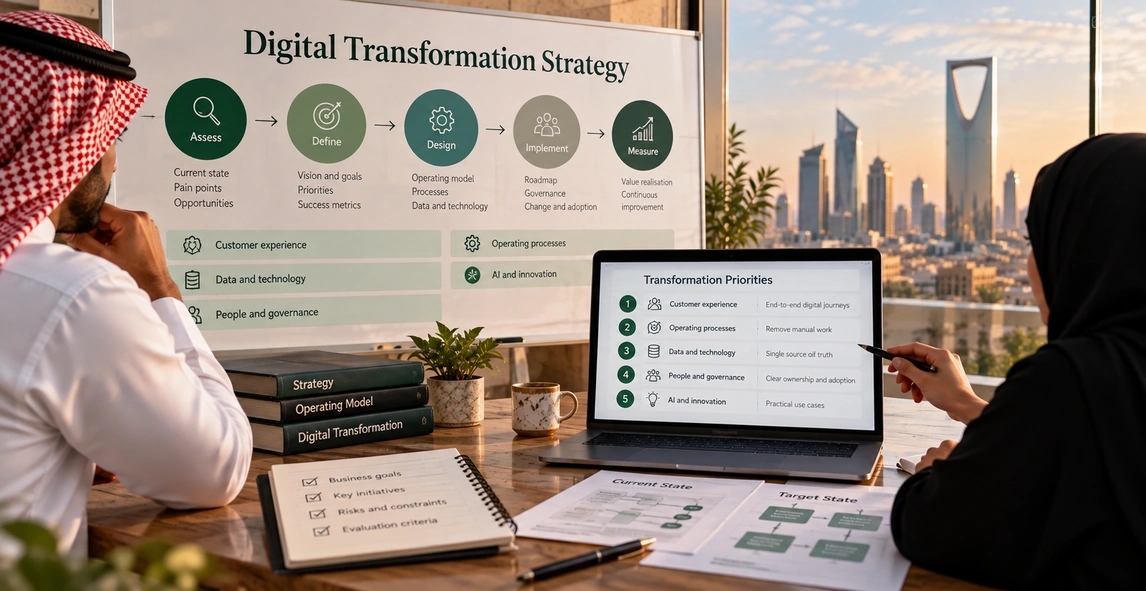
Digital Transformation Strategy Companies in Saudi Arabia: How to Choose
No published ranking names the best digital transformation strategy company in Saudi Arabia. Here are the criteria, cost drivers and questions that decide it.

Best Digital Operating Model Companies in Saudi Arabia: How to Choose
Why no one can rank the best digital operating model companies in Saudi Arabia, what these services cover, what moves the fee, and what to verify before you sign.

Digital Transformation Services Companies in Saudi Arabia: How to Choose
What digital transformation services companies in Saudi Arabia do, why we publish no ranking, what drives the cost, and how to verify a provider before signing.
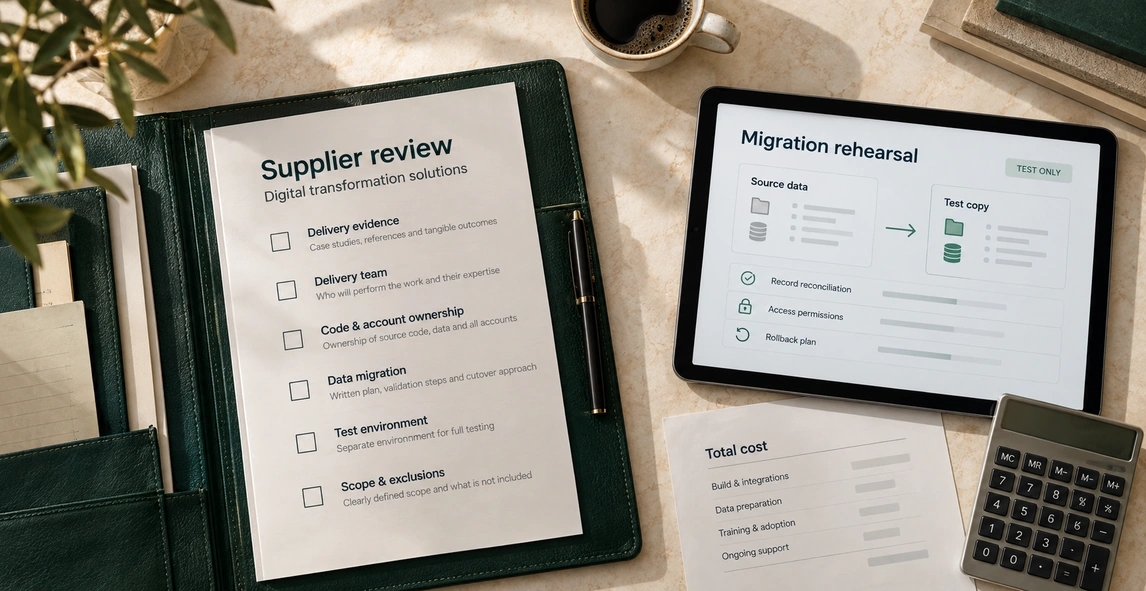
Digital Transformation Solutions Companies in Saudi Arabia
We name and rank no companies without verified evidence. This guide gives the criteria, the questions and the cost method you need to choose one yourself.

Digital Transformation Companies in Saudi Arabia: How to Choose One
No independent ranking settles which digital transformation company in Saudi Arabia is best. Here are the criteria and questions to decide for yourself.