
Digital Transformation Companies in Saudi Arabia: How to Choose One
Digital Transformation Companies in Saudi Arabia: Services, Costs and Selection Criteria
The direct answer: we cannot name the best digital transformation company in Saudi Arabia, and we will not. We found no independent published ranking of these firms, so this guide names none and ranks none — and it does not put us at the top of a list we say cannot be ranked. The best company for you is the one that fits your constraint, and that is settled by criteria rather than reputation.
We also publish no figure here that we have not verified against a primary source: no price ranges, no typical project durations, no ROI percentages, no client results, no market sizes. Where a heading asks for a number of that kind, the answer explains what determines it and how to work it out for your own organisation.
Digital transformation, defined by what changes in the work
It is redesigning how an organisation works so that technology actually changes the work: shorter processes, consistent data, faster decisions. The test of whether it happened is not what was installed — it is whether the steps people take and the decisions they make are different afterwards.
It means changing the way work is done using technology, rather than adding new tools on top of an unchanged process. A practical indicator: if the same approvals, handoffs and re-keying still exist after the project, a system was bought but nothing was transformed.
Digitization, digitalization and transformation are three different things
Digitization converts paper and analogue records into digital files. Digitalization uses digital tools to run an existing process, usually faster. Transformation redesigns the process itself and may remove a step rather than speed it up. The sensible order is to simplify, redesign the process, and then automate what remains worth automating.
The two pressures that made it a business priority
Two pressures can show up in organisations and both can be checked in yours: the cost of maintaining older systems rises while the number of people who can maintain them falls, and customer expectations are set by the best digital services people use daily, not by your competitors. We publish no global spending or adoption figure to support this — if neither pressure appears in your own numbers, your priority is probably elsewhere.
Three core pillars: technology, people, process
Three, and a programme that drops one of them usually stalls: technology, people and culture, and process design. A common failure pattern is funding the first and assuming the other two will happen by themselves.
Technology makes the redesigned process possible — it does not select it. Its practical contribution is removing constraints: work that had to be manual, data that could not be joined, capacity that had to be bought in advance. Choosing tools before the process is settled is how organisations end up automating a step that should have been deleted.
People decide whether the new way survives contact with a busy week. The measurable version of "culture" is simple: who owns the decision, whether staff were involved before the design was frozen, and whether the old route is still available. If the spreadsheet still works, teams may keep using it.
As for process redesign: it can hold much of the value and is relatively inexpensive to do first. Map one process end to end and count two things: how many times the same information is entered, and how many times work waits for an approval that changes nothing. Those two counts are the case for the project.
What a digital transformation company is accountable for
A firm that takes responsibility for the change itself — process, systems, data and adoption — rather than for one deliverable inside it. The distinction matters commercially, because it determines who is accountable when the parts do not fit together.
The five things such a firm actually does
In practice, five things: assess how the work runs today, design the target process, select and implement the systems, move and reconcile the data, and get people using it. Firms differ mostly in which of the five they will own. Ask which ones are in scope in writing, because projects can fail at the gaps between them.
Not a marketing agency, and not an IT consultancy
A marketing agency generates demand; a transformation firm builds the capacity to serve it. The order matters: running campaigns against a process that cannot deliver turns a demand problem into a complaints problem. Some firms offer both — ask for separate evidence of each rather than assuming competence transfers.
An IT consultancy is usually accountable for systems, architecture and delivery. A transformation firm is accountable for whether the business outcome changed, which includes process and adoption work that sits outside IT. The useful question is not what they call themselves but what the contract makes them answerable for.
The organisations that need one
Organisations whose constraint is coordination rather than capability: several systems that do not talk, a process nobody owns end to end, or data that cannot answer a basic operational question. If the problem is one well-defined build, a specialist supplier is cheaper and lower risk than a transformation engagement.
The Saudi context in 2026, stated as demand rather than destiny
The honest framing is demand-side rather than destiny: organisations in the Kingdom face rising regulatory reporting requirements, a fast-moving customer expectation baseline, and a national policy agenda that favours digital economy growth. We publish no figures for market size or growth, because we have not verified any.
Vision 2030 shapes sectors, not individual mandates
Saudi Vision 2030 is the Kingdom's published programme for diversifying the economy, and developing the digital economy is one of its stated themes. Its effect on any single company is indirect: it shapes which sectors expand and the level of service customers compare you against. Verify any specific target or figure attributed to it in the official publications before citing it.
Government initiatives, and why we do not list their terms
Several national bodies and programmes address digital government, data and AI, and support for smaller enterprises. We do not list programmes and their eligibility terms here, because those terms change and a reader may set a budget on them. Check what is currently open directly with the relevant authority.
The DGA, NEOM and SDAIA in practical terms
The DGA is the national body responsible for regulating and developing digital government in the Kingdom. What matters to a private organisation is indirect: government digital services set the service standard your customers experience, and where you interact with government systems, the DGA's published requirements are the reference. Confirm current obligations with the authority rather than with a vendor.
NEOM is an announced large-scale development project in the Kingdom with a stated technology-led design. We have verified no measured effect of it on digital transformation practice inside other companies, and we will not claim one. What can be said as inference rather than result: large programmes raise expectations and increase competition for skilled people, and both reach you indirectly.
SDAIA is the national authority for data and artificial intelligence in the Kingdom. Its practical relevance to a business project is regulatory before it is aspirational: where your project stores, moves or processes personal data, published national data protection requirements govern the design. Treat those requirements as a design input at the start, not a compliance review at the end.
Digital economy growth, and the figure we do not publish
We publish no growth figure, because we have verified none from a primary source and a number of that kind is usually what a reader remembers. What you can use instead is specific to you: the share of your own customer interactions that already begin digitally, and how that share moved over the last two years.
What makes the Saudi market distinct
Three practical characteristics rather than claims: bilingual delivery is a real design requirement, not a translation task; specific regulatory obligations such as e-invoicing apply regardless of company size; and local payment and identity expectations differ from defaults shipped in international platforms. Each affects scope and cost, so each belongs in the brief.
The service groups on offer, and the constraint each one removes
The service groups below cover much of what is offered. Do not buy the full set: buy what removes the constraint stopping you now, then reassess once it is actually in use.
Digital strategy consulting
Deciding what to change and in what order — which processes, which systems, which sequence, and what the money is expected to do. Its useful output is a document you can hand to any supplier: current state, target state, constraints, acceptance criteria. Strategy work that ends in a deck and no testable requirements has produced nothing you can buy against.
Website and e-commerce development
The customer-facing channel plus what sits behind it: catalogue, orders, payment, and the handoffs to fulfilment and accounting. Frequently omitted scope items can become expensive later — crawlability and page speed, bilingual handling, accessibility, and ownership of the domain, hosting and analytics accounts in your own name.
Marketing automation
Running repeatable customer communication from system data rather than by hand: onboarding sequences, order status, reactivation. It supports transformation only when the underlying data is trustworthy — automation applied to inconsistent records sends the wrong message reliably and at scale.
Data analytics and business intelligence consulting
Making numbers consistent enough to act on, then reporting them. Many reporting problems are definitional rather than technical: two systems count a "customer" differently. Expect the first weeks of any BI engagement to be spent settling definitions, and treat that as the deliverable rather than a delay.
Cloud migration and infrastructure modernization
Moving systems onto cloud infrastructure and operating them there, so capacity becomes a setting rather than a purchase. It is not automatically cheaper — cost is consumption-based and grows with undisciplined design. Make sure cloud accounts are registered to your organisation with the supplier granted access, not the reverse.
AI and machine learning integration
Applying models to defined tasks inside an existing process: classification, extraction, prediction, first-draft generation. The order matters — a model built on inconsistent data inherits the inconsistency and presents it confidently. Define the task and the measure before selecting the technology.
CRM and ERP implementation
Putting in the systems of record for customers and for core operations, plus the integrations around them. These projects are governed by data migration and process change rather than software installation, which is why they can fail when run as purely technical projects. Require parallel running and a reconciliation of figures before final cutover.
Cybersecurity consulting inside the programme
Designing identity, permissions, patching, encryption, logging and tested backups into the programme rather than adding them afterwards. The transition period is itself a period of elevated exposure: temporary supplier access tends to be broad and to outlive its purpose, so it should be time-limited and revoked on completion.
Change management and employee training
The work of getting the new way used: deciding who owns each process, involving the people who run it before the design is frozen, training by role, and retiring the old route. It is often cut to fit a budget, and its absence can undermine the rest of the spend.
Training is critical because a system used incorrectly produces data you cannot trust, which removes the main benefit you paid for. Ask for durable outputs rather than a session: a short role-based guide, a recording, and one trained internal owner who can train the next joiner without calling the supplier.
Companies can address resistance to change by removing its causes rather than relying on persuasion. Three recurring causes are: the new way is slower for the person doing it, nobody explained what happens to their role, and the old route still works. Fix the first, answer the second honestly, and close the third on a stated date.
The Vision 2030 alignment, at the level of direction
It aligns at the level of direction rather than obligation. Vision 2030 is a published national programme; it does not impose a transformation requirement on an individual company, and we do not present it as one. Where specific obligations exist, they come from sector regulators, not from the Vision document.
The digital goals, read in the source
Developing the digital economy and digital government are among the programme's stated themes. We do not restate specific targets or percentages here, because we have not verified them against the official publications and a misquoted target travels further than a correction. Read the goals in the source before you build a business case on them.
Economic diversification runs through capability
The mechanism is capability rather than sector: organisations that can launch, measure and adjust quickly can enter new lines of business at lower cost than organisations that cannot. For a single company the practical question is narrower — how long does it take you to test a new offering and get a reliable answer?
Smart city projects, and the link we do not claim
Those projects are announced developments with stated technology components; we claim no measured link between them and private-sector transformation outcomes. Where a supplier cites smart city work as evidence, ask what they specifically delivered and whether it is running, because large programmes have many contributors.
Tourism, where the mechanics are concrete
In tourism the operational mechanics are concrete: bookings, multilingual content, payments, and the handoff to operations on the day of service. We publish no visitor or revenue figures. The relevant test for a tourism business is whether a visitor can complete a booking end to end without contacting a human and receive the service that was promised.
Seven sectors, and the different mechanism in each
We have verified no data that ranks sectors and will not publish a ranking. The structural pattern that can be stated: the sectors that benefit first are those whose transaction can be completed digitally end to end, or that carry heavy reporting and compliance obligations. What follows describes mechanisms, not an order of merit.
Retail and e-commerce
By connecting the order to stock, fulfilment and accounting without re-keying, which cuts errors and makes order status knowable to both the customer and you. The usual bottleneck is not the storefront but what sits behind it: true stock availability, returns handling, and payment reconciliation.
Banking and financial services
Through onboarding, servicing and reporting that run on consistent records, and through controls that are enforced by the system rather than by procedure. The binding constraint is regulatory: identity, audit trail, data residency and retention govern the design, and they sit ahead of any efficiency gain in the sequence of decisions.
Healthcare
Scheduling, reminders and fewer missed appointments, plus linking the appointment to the record and to billing. Patient data privacy governs everything here: where data is stored, who holds administrative access, and how access is logged. Settle those before discussing features.
Real estate and construction
In real estate, by keeping unit and listing records consistent across channels and preserving the enquiry source through to the closed deal. In construction, by making project documentation, approvals and variations traceable, which is where disputes and cost are concentrated.
Government and public sector entities
Through auditable service journeys and reporting built from a single set of records. The requirements are stricter than in most private projects — identity and permissions, change logs, data location — and they are difficult to retrofit, so they belong in the design from the first day.
Education
By unifying admissions, scheduling, assessment records and parent communication into one path instead of separate files and spreadsheets. The load is seasonal, and the enrolment period is the real test of any system an institution buys — specify it as the peak the platform must handle.
Logistics and supply chain
Through visibility: knowing where a consignment is, what it cost to move, and why it was late, from records rather than phone calls. The hardest part is rarely tracking — it is reconciling data from carriers and partners whose formats and definitions differ from yours.
The five stages, and what each one has to produce
Five stages are common. What matters is not the names but that each has a written output, an acceptance criterion and a payment tied to it — and that the plan separates supplier working days from your review days, because client review time can materially affect the schedule.
Assessing current digital maturity
By measuring the work rather than scoring yourself against a model. Take your three most important processes and record, for each: cycle time, manual hours, error and rework rate, and how many systems hold the same record. Those four numbers are both your assessment and your baseline.
Building the roadmap
By sequencing on constraint and dependency rather than ambition. Put first the change that removes the bottleneck stopping work today, then the items that depend on it. Each stage should deliver something usable on its own — a roadmap where nothing works until the final phase is a single large bet.
Choosing the technology stack
Choose for what you must integrate with, what your team or your market can maintain, and how you would get your data out. The last is often overlooked, and it strongly affects whether the decision is reversible.
Implementing and piloting
On a slice narrow enough to fail cheaply and real enough to be informative: one team, one process, real data. Define in advance what would make you stop, because a pilot with no stopping condition becomes a rollout by default regardless of what it showed.
Measuring and scaling
Against the baseline you recorded before starting; without it, any claim of improvement is an impression. Scale only what met its criterion, and scale by team or process rather than all at once, so that what breaks at volume breaks somewhere recoverable.
The KPIs worth tracking are five practical ones: process cycle time, share of transactions completed without manual intervention, error and rework rate, actual user adoption, and time to recover from an outage. Pick three and review them monthly. Twenty indicators nobody reviews are worse than three that drive a decision.
Review the strategy on a fixed cadence that ends in a decision — a quarterly review may suit many organisations — plus a review whenever a stated assumption breaks. The failure mode is not reviewing too rarely; it is reviewing regularly and never deciding to stop anything.
The technologies in play, and what each is structurally good at
The technologies below commonly appear in current programmes. Treat the list as a menu of mechanisms rather than a requirement — each is worth buying only where it removes a constraint you can name.
Artificial intelligence
Mainly by making previously manual judgement tasks partly automatable: classifying, extracting, matching, prioritising. The prerequisite is consistent data and a defined task with a measure. We publish no adoption or productivity figures, and treat unqualified claims of them with the same caution.
Generative AI in Saudi businesses
The uses we can describe without overstating are first-draft generation, summarisation, and support assistance grounded in the organisation's own content. Two constraints are practical rather than theoretical: outputs need a review step where the cost of being wrong is real, and Arabic quality should be tested on your own material before commitment. We have not verified adoption rates and publish none.
Cloud computing
By removing capacity planning as a blocker and making environments reproducible, which is what allows testing before release. The trade is ongoing consumption cost and a dependency to manage: keep accounts in your own name, and know what it would take to move.
The Internet of Things
To capture state from physical operations — location, condition, usage — so decisions run on measurement rather than reports. The cost is rarely the sensors; it is the connectivity, the data pipeline and the maintenance of devices in the field. Pilot on one asset class and count the true running cost before scaling.
Big data
Less than the term suggests for most organisations. Volume helps when the questions are about patterns across many events; many operational questions fail for a simpler reason — inconsistent definitions across systems. Fix the definitions first, and a modest data set answers most of what you need.
Blockchain
Its established use is where multiple parties that do not fully trust each other need a shared, tamper-evident record — certain supply chain provenance and documentation cases. Inside a single organisation, a database with proper access control and audit logs is often sufficient, and we would say so rather than sell the more fashionable option.
Automation and RPA
By driving systems through their interfaces where no integration is available, which makes it useful with software that cannot be modified. Its weakness is fragility: it can break when a screen changes. Treat it as a temporary bridge and plan its replacement by a real integration.
The challenges that show up repeatedly in delivery
The challenges below are the ones that show up repeatedly in delivery. Four of the five are management problems rather than technical ones, which is also why buying better technology rarely resolves them.
The recurring causes of failure
We have verified no failure rate statistic and will not repeat the widely quoted ones. The recurring causes we can describe: no single internal owner with authority, technology bought before the process was simplified, data migrated without cleaning, and change management excluded from scope to fit a budget.
Budget constraints
By narrowing scope rather than thinning it across everything. Fund the one change that removes today's bottleneck, prove it in use, and let the saving argue for the next stage. A thinly funded programme across six areas may fail to deliver anything that works end to end.
A shortage of digital talent
By separating what must be internal from what can be bought. The roles that have to be internal are ownership and decision-making; build and specialist skills can be contracted. Where you contract, require documentation and handover quality as acceptance criteria, or the shortage becomes permanent dependency.
Employee resistance to new systems
By involving the people who run the process before the design is frozen, making the new route faster for them than the old one, and setting a date when the old route closes. Resistance that persists after those steps may signal a design problem rather than a people problem.
Data security during the transition
By treating the transition as the high-risk period it is: least-privilege access including for the supplier, time-limited temporary permissions, encryption in transit and at rest, logging of administrative access, and backups that have actually been restored in a test. Write revocation of supplier access into the contract with a date.
Avoiding the wrong technology partner
By testing claims before signing: inspect running systems rather than screenshots, ask who physically does the work, speak to a past client whose project went badly, and read what the proposal excludes. Many warning signs of a poor selection are visible in the exclusions section before signing.
Six benefits, each with the condition it depends on
The benefits below are mechanisms, each with a condition it depends on. We publish no percentages for any of them — all of them are measurable in your own organisation if you record a baseline first.
Customer experience
By making what the customer needs possible without contacting anyone, and by making what the interface promises match what operations can deliver. In mid-sized organisations many complaints are not about the interface — they are about order status, delays and inconsistent answers, all of which are operating model symptoms.
Operational efficiency
By removing handoffs between teams, entering data once instead of three times, and ending waits at approvals that add no decision. This is calculable in advance: count the manual hours per month and the re-keying events in one process, and you have the size of the opportunity before you spend anything.
Revenue and ROI
Indirectly, and we publish no ROI figures. The mechanisms are shortening the time between a decision and a launch, and removing the friction that loses orders you already had. Start by counting the transactions that began and did not complete last month and why each stopped — that number is more useful than any published benchmark.
Data-driven decision-making
By forcing definitions to be settled — what counts as a customer, an order, a completed job — and then making the numbers consistent enough to act on. That definitional work is unglamorous and can be one of the most valuable outputs of the programme.
Competitive advantage
Through one durable mechanism: speed of learning. An organisation that can test and measure in two weeks compounds an advantage over one that needs a quarter. Owning a particular technology confers little, because a competitor can buy the same thing.
Business scalability
By breaking the link between volume and headcount for the routine path, so that growth does not require proportional hiring. The condition is that exceptions are handled well rather than automated — exceptions are what consume time, and automating them is usually more expensive than handling them by hand with a good interface.
Choosing a firm: criteria before names
By ordering the criteria before looking at names. A practical time-saving step is to write one brief describing what you need, send it to three firms, and compare what each excluded from scope — exclusions reveal more than proposals do.
Experience you can inspect
Experience you can inspect: systems running today that you can open, integrations of the kind you need, and familiarity with the regulatory requirements that apply to your sector. Ask what their specific role was on each reference, because large deliveries often have several contributors.
Certifications and partnerships as inputs, not verdicts
Treat these as inputs, not verdicts. A platform partnership indicates a commercial relationship and some trained staff; it does not indicate fit for your problem, and partner tiers are awarded on criteria that include sales volume. Verify any certification or partner status with the issuing body rather than accepting a logo, and weigh inspectable delivery evidence more heavily.
Local market knowledge, tested with one precise question
Important in specific, checkable ways rather than as a general virtue: correct bilingual handling including right-to-left Arabic that was designed rather than machine-flipped, familiarity with obligations such as e-invoicing, and awareness of local payment and identity expectations. Test it with one precise question from your own operation.
The questions to ask before signing a contract
- What exactly is excluded from scope?
- Who performs the work, and is any of it subcontracted?
- Who owns the code, the cloud accounts, the domain and the analytics?
- How will data be migrated, and how do we verify nothing was lost?
- What is the rollback plan if cutover fails?
- What does support cover after launch, and with what response times?
- How many revision rounds are included, and how are extra ones priced?
- Show us a project that went wrong and what you changed afterwards.
Red flags worth a written clarification
A proposal with no exclusions section, unwillingness to name who does the work, accounts registered in the supplier's name, no separate test environment, no written acceptance criteria, and reluctance to put you in touch with any past client. None proves bad faith; each justifies a written clarification before signing.
A guaranteed business result is the clearest of them: it means the outcome being guaranteed depends on factors the supplier does not control — your data quality, your decision speed, your staff adoption. A guarantee of a specific business result is a commercial signal rather than a technical one. What can legitimately be guaranteed is delivery against written acceptance criteria and defect correction within a warranty period.
No case studies and no references is harder to weigh, because with no inspectable work, you are buying on assertion alone. The absence is not always disqualifying — confidentiality is real in some sectors — but it shifts the burden: ask for a reference call under NDA, a live demonstration environment, or a paid, small first phase that lets you test the working relationship cheaply.
What sets the cost, and why we publish no price
We publish no price and no range that we have not verified. The reason is practical rather than evasive: any figure printed here becomes a budget for a reader who does not know what it included, and the scope difference between two proposals for the same "transformation" may be wider than the price difference. What follows is what sets the number and how to get a real one.
Six factors that set the number
Six: how many systems must be integrated, the state of your existing data and how much needs cleaning and migrating, whether functionality is built from scratch or configured on a product, security and compliance requirements, the number of users and roles, and the level of post-launch support. Data migration is often underestimated among the six factors.
How pricing models are structured
Commonly a build fee plus an ongoing subscription for operation and support, sometimes with time-and-materials for change requests. Watch what falls outside both — hosting, licences and third-party services may be charged separately. Ask for a full annual cost of ownership rather than a build price.
The calculation for a small or medium business
We do not answer that with a general yes. It is calculable: estimate the manual hours removed per month, multiply by loaded hourly cost, add the cost of errors and rework, and compare against full annual cost of ownership. If the difference does not appear in that simple calculation, the scope is probably wider than you need right now.
Calculating ROI against a baseline
By recording a baseline before starting and comparing after: manual hours, cycle time, error and rework rate, and one business result you can attribute. Attribute conservatively and state what you could not isolate. An ROI number calculated without a pre-project baseline is an estimate presented as a measurement.
The future, offered as a reading rather than a forecast
We publish no forecasts we have not verified and no market projections. What can be said as a reading rather than a result: deeper integration between systems, and rising expectations around data handling and privacy. What that means for a decision today is narrow — build what can be changed later, and keep ownership of your code and your data.
Trends already visible and checkable
Rather than predict, we would point at what is already visible and checkable: more system-to-system exchange through APIs, more pressure on data quality and definitions, and more scrutiny of how personal data is processed. The decision each of these supports is the same one — avoid closed architectures your data cannot leave.
AI regulation
We will not describe rules that have not been published or speculate about their content. What is actionable now: where an AI feature processes personal data, existing data protection requirements already apply, and decisions affecting customers should be explainable and logged. Building that way costs little now and avoids rework if requirements tighten.
The metaverse and Web3
We have verified no business outcomes in this area and will not assert any. For most organisations the honest position is that these are not current operational priorities, and a supplier leading a transformation proposal with them is signalling their interests rather than your constraint.
Sustainability as a data requirement
Its most concrete link to digital work is measurement and reporting: environmental data has to come from systems rather than from an annual spreadsheet exercise, and reporting requirements may tighten. If sustainability reporting applies to you, treat it as a data requirement to design for rather than a communications exercise.
How Ay.sa works, stated so you can compare it
We will not argue that we are the best choice — that is a judgement we hold no independent evidence for, and this guide has just said no such ranking exists. What we can describe is how we work, so you can compare it against any other proposal.
Four commitments you can check in a contract
We hold no independent comparison between ourselves and other firms and will not claim a difference we have not verified. What we can state are commitments you can check in a contract: written scope with acceptance criteria, code and accounts registered in your name, exclusions stated up front, and a baseline recorded before work starts so the result is measured rather than asserted. Hold every proposal you receive to those four.
The client results we do not publish
We do not publish client results, percentages or named outcomes. Client performance data belongs to the client and we hold no approvals to publish it, and figures of that kind are not verifiable by you in any case. What we can offer instead is specific and checkable: a reference conversation where the client agrees to it, and a defined first phase small enough that you judge the work by what it produced for you rather than by what it produced for someone else.
Working across the GCC
We work in Arabic and English and design bilingual systems as bilingual from the start rather than as a translation layer. Where a project touches requirements specific to a market — invoicing, payments, identity, data handling — we confirm those against the regulator's current published requirements rather than assuming they carry across from another country.
Getting started
With a scoping session whose output is a requirements document you can use with us or with anyone else: the processes that will change, the integrations required, acceptance criteria, and the numbers to record as a baseline. Contact us through the Ay.sa website to arrange it.
0 Comments
No comments yet. Be the first to comment!
Related Blogs

Best Digital Modernization Company in Saudi Arabia: How to Choose One
Why nobody can rank the best digital modernization company in Saudi Arabia, what these firms actually do, what moves the cost, and what to verify before you sign.
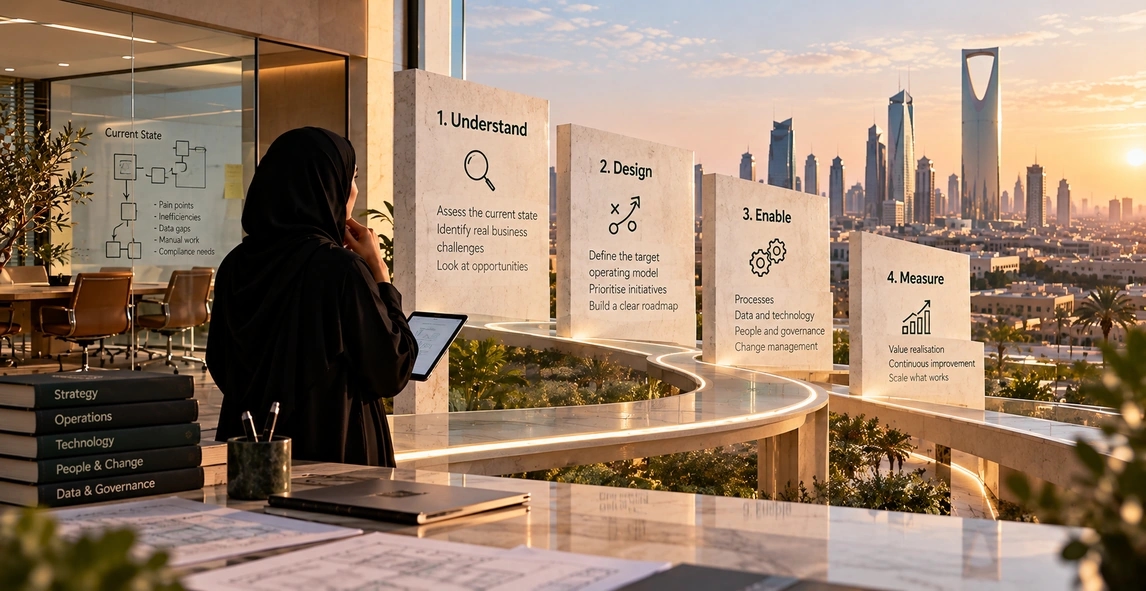
Best Digital Transformation Consulting Company in Saudi Arabia: How to Choose
No published ranking names the best digital transformation consulting company in Saudi Arabia. Here are the criteria, cost drivers and questions that decide it.
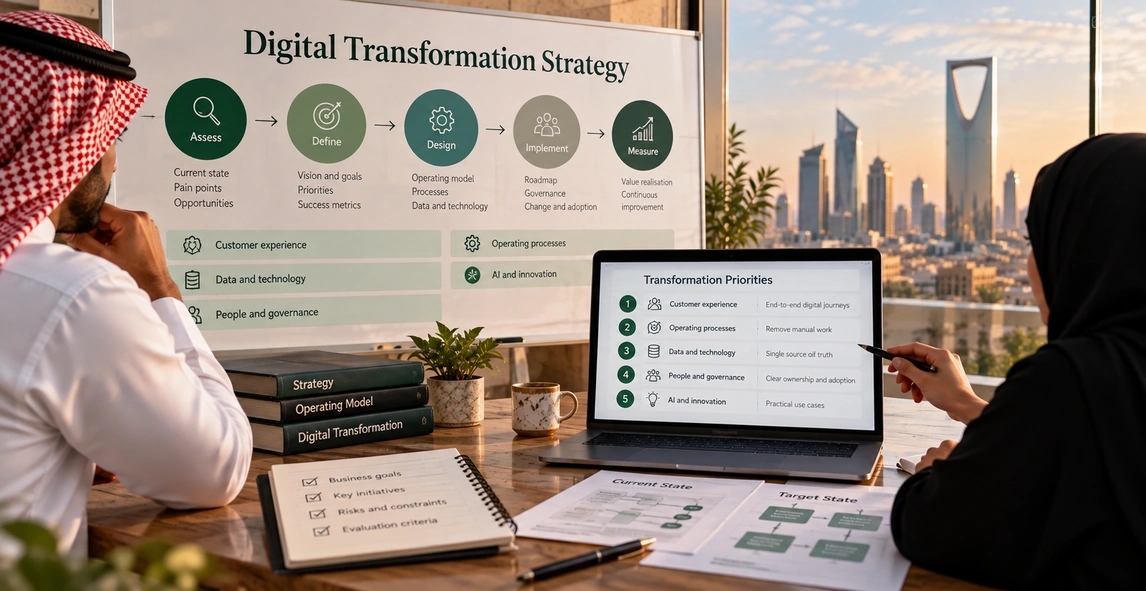
Digital Transformation Strategy Companies in Saudi Arabia: How to Choose
No published ranking names the best digital transformation strategy company in Saudi Arabia. Here are the criteria, cost drivers and questions that decide it.

Best Digital Operating Model Companies in Saudi Arabia: How to Choose
Why no one can rank the best digital operating model companies in Saudi Arabia, what these services cover, what moves the fee, and what to verify before you sign.

Digital Transformation Services Companies in Saudi Arabia: How to Choose
What digital transformation services companies in Saudi Arabia do, why we publish no ranking, what drives the cost, and how to verify a provider before signing.
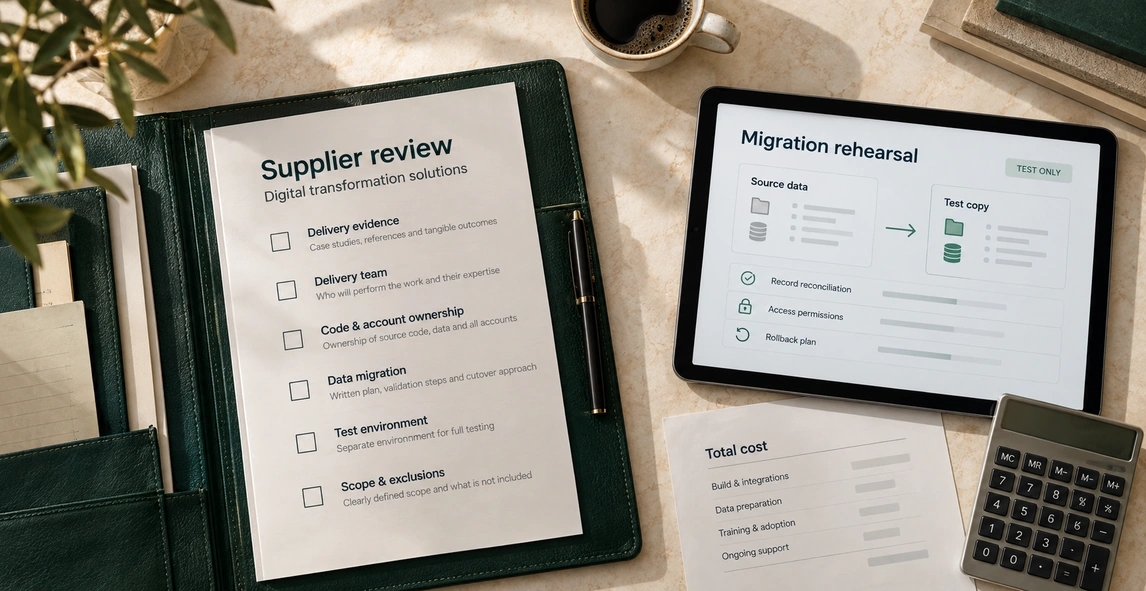
Digital Transformation Solutions Companies in Saudi Arabia
We name and rank no companies without verified evidence. This guide gives the criteria, the questions and the cost method you need to choose one yourself.