
The Digital Transformation Business Case: How to Get It Approved, and When to Stop
The Digital Transformation Business Case: How to Get It Approved, and When to Stop
Transformation proposals can be declined when the return is asserted rather than demonstrated or when the proposal lacks a clear condition for stopping. A proposal with no defined failure condition may appear insufficiently examined.
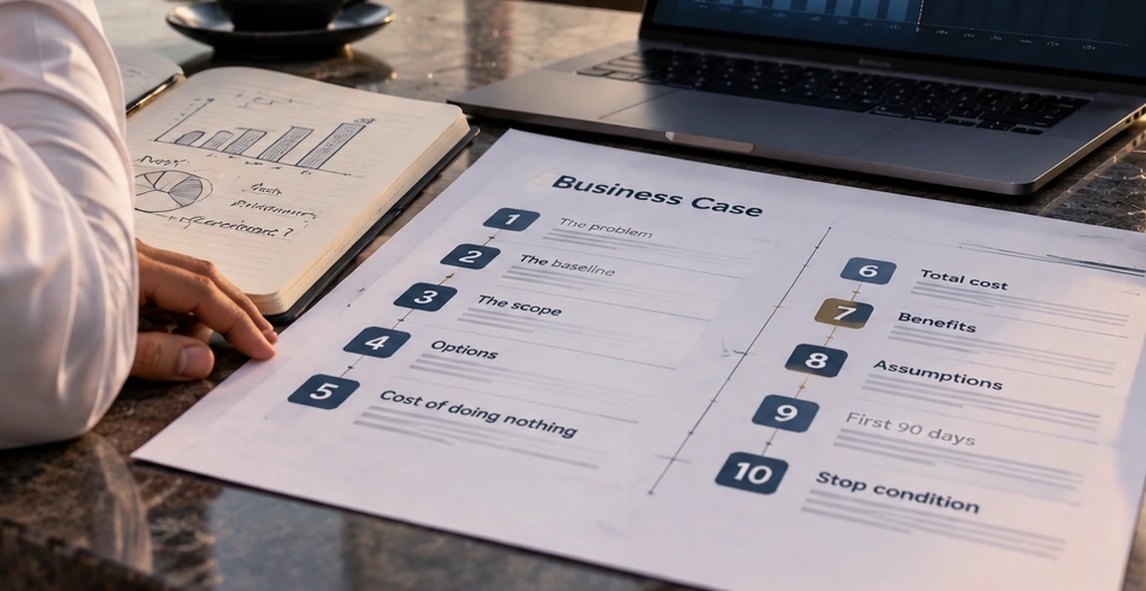
AY prepared the template below for this guide, and it is set out here for you to use yourself. The template contains ten sections. Sections seven and eight deserve particular attention, while section ten is easy to overlook.
A transformation business case template
|
# |
Section |
What it should contain |
|---|---|---|
|
1 |
The problem, in operational terms |
A process, its current duration or error rate, and who feels it — not "we need to modernise" |
|
2 |
The baseline |
A recorded figure with the measurement period and method, dated before the proposal |
|
3 |
The scope, as one process |
One end-to-end process, with what is explicitly excluded |
|
4 |
The option set |
At least three: do nothing, a limited option, and the proposed one — each costed |
|
5 |
The cost of doing nothing |
What accumulates over twelve months if this is deferred, in the six places it accumulates |
|
6 |
Total cost, including operation |
Build plus the annual cost of running it, over at least three years |
|
7 |
Benefits, split by defensibility |
Three tiers: directly measurable, indirectly attributable, and asserted — with the third clearly labelled |
|
8 |
What has to be true |
The assumptions the return depends on, each with who owns it and how it will be checked |
|
9 |
The first 90 days |
One complete, measurable result inside 90 days, and what it demonstrates |
|
10 |
The stop condition |
The specific indicator and threshold at which the programme is halted, and who decides |
What you do with this: write sections 2 and 10 first. If you cannot write section 2 because no baseline exists, measuring one is the actual next step — over a period and sample that represent the process, which for a seasonal or low-volume activity is longer than a fortnight. Where no pre-change baseline can be taken, say which substitute you used and what it does not tell you. If you cannot write section 10, reviewers may define the condition during the approval process instead.
Split the benefits by how far they can be defended
A frequent reason a return is questioned is that more and less defensible benefits are presented as one number. Separate them and the case becomes more credible, not less:
- Directly measurable. A process duration, an error or rework rate, a cancellation rate, a cost line that disappears. You can show the before and after. These provide the strongest evidence in the case.
- Indirectly attributable. Retention, conversion, employee turnover. Real, influenced by many things, and honest to present as contribution rather than cause.
- Asserted. Competitiveness, agility, readiness. Worth stating in one sentence and not worth quantifying — a number attached to these is the line an experienced approver is most likely to challenge, and that challenge puts the tiers above it in doubt.
What you do with this: build the financial case entirely from the first tier. Mention the second as contribution. Keep the third to one sentence. A smaller, fully defensible case may be more credible than a larger one containing an unsupported line.
The cost of doing nothing, in six places
"Do nothing" is often presented as costing zero, and that is rarely accurate in either direction — deferral carries costs that do not appear on an income statement, and it also avoids the cost and disruption of the change itself. Model it as an option with its own costs, benefits and uncertainty rather than as a baseline of zero. The deferral costs worth checking: integration (more systems join the technology environment), data (new records under old definitions), knowledge (the people who understand the current system leave), regulatory (controls update, the system does not), adoption (workarounds become embedded), and competitive position. The full indicator, with what each one costs when you finally move, sits in the digital modernization guide.
What you do with this: take the six dimensions into section 5, put your own figures against the one system you have deferred longest, and set them against what the change itself would cost and disrupt. The figures will be rough and do not need to be precise — they need to exist on both sides, so the comparison is between two costed options rather than between a costed proposal and an assumed zero.
Write the stop condition before you present
A stop condition is a named indicator, a threshold, a date, and a person. For example: if the process duration recorded in section two has not moved by an agreed margin ninety days after the first release, the programme halts and returns to the sponsor for a decision.
Three things make it work, and they are commonly absent:
- The indicator is the same one in section two. A stop condition measured on something other than the baseline is not a stop condition.
- A named person can invoke it. Where no one holds the authority to stop a phase, delivery may continue without a clear decision point.
- Stopping is described as a valid outcome, not a failure. Otherwise the condition may exist on paper without being invoked in practice.
What you do with this: present the stop condition yourself, in the meeting, before anyone asks. It can shift the discussion from selling the proposal to examining its assumptions and risks.
What the national context does and does not do for your case
Vision 2030 and the national digital programmes are useful in a private-sector business case for one specific purpose: they establish that the expectations your customers and partners bring are rising because they are being met elsewhere. They do not oblige a private company to do anything, which is why your case is competitive rather than compliance-driven.
The measured public figures are what a board recognises. The National Transformation Programme's 2024 annual report put the government digital transformation index at 87.14% against a target of 68%. The Digital Government Authority, which regulates and measures digital government performance and publishes the results, recorded 226 entities at 85.53% in its 2024 measurement, a digital experience maturity index of 86.71% across 50 platforms, and a website efficiency index of 76.24% across 250 websites. The Kingdom placed sixth globally in the United Nations 2024 E-Government Development Index. On the demand side, the Communications, Space and Technology Commission's 2025 internet report recorded average monthly consumption of 53 gigabytes per user, average fixed broadband speed of 216 megabits per second, and 45.2% adoption of AI tools.
What you do with this: use these figures to set the expectation level your customers arrive with — one paragraph, early. Do not use them to justify a specific investment: none of them describes your process, and an approver will say so. The specific justification comes from section two, which is about you.
These figures are published by the named bodies for the periods stated. Verify them against the current publication before using them in a board paper, as measurement periods and definitions change.
Where business cases get rejected, and what fixes each one
"The benefit is not attributable." The case relied on the second or third benefit tier. Fix: rebuild the financial case from tier one only.
"The cost looks incomplete." The annual operating cost was missing. Fix: present a three-year total including operation, which is also what makes options comparable.
"This is too big to approve." The scope was the whole programme. Fix: ask for approval of one process with a 90-day result and a stop condition, and fund the next phase from what it shows.
"We have heard this before." A previous programme delivered nothing visible. Fix: name it, say what went wrong in it specifically, and show which section of this case addresses that failure. Raising it yourself is far stronger than being asked.
Who has to be in the room
Three roles can materially improve the business case, and the third is often overlooked:
- The process owner, who confirms the baseline is real and the described process is the one people actually follow.
- Finance, early rather than at approval — so the cost structure is agreed before the argument is about the number.
- The person who will operate the system afterwards. Their absence can contribute to the annual operating cost being omitted.
What you do with this: bring the third person into the drafting, not the presentation. Their input is especially relevant to sections 6 and 10 and can make the case more complete.
The adjacent decisions, and where they are made
- What am I buying, and what sets its price? The digital transformation services guide.
- Which of my existing systems do I keep, replace or retire? The digital modernization guide.
- Who decides what once the change lands? The digital operating model guide.
- How do I evaluate and compare transformation companies? The guide to choosing a transformation company.
- Should we build this capability in-house instead? The guide to choosing a transformation provider.
How AY works
Where AY is involved in a business case, the useful division is that the measurable material — the problem in operational terms, the baseline, the scope, the costed options and the first milestone — can be assembled with an external party, while the benefit tiers, the assumptions and the stop condition stay with the organisation that will act on them. A stop condition written only by an adviser may lack sufficient internal ownership to be applied.
The part worth being strict about is the baseline: measure it from your own systems, and say so when a process cannot be baselined rather than estimating one and presenting it as observed. Examples are in our work, and the scope is set out in enterprise digital transformation.
Next step
Start recording section two. A baseline on one process is among the least costly items in this template and the section the others depend on, though it does take staff time and sometimes access approvals. Choose a period that represents the process rather than a fixed fortnight.
If the baseline cannot be recorded because the process runs across systems that do not report it, that is the point at which involving an outside party becomes useful. Talk to us about whether an assessment fits your case and what it would cover — the scope and outputs of any assessment are agreed before it starts rather than assumed in advance.
0 Comments
No comments yet. Be the first to comment!
Related Blogs
What a Digital Modernization Company Does, and Which Type Fits Your Gap
Three kinds of firm sell digital modernization and they cover different layers. Identify the layer your gap sits in, then ask every candidate for the same five pieces of evidence.

Build or Buy: Choosing a Digital Transformation Provider Without Outsourcing the Wrong Thing
Decide which capabilities should sit outside your organisation before comparing providers. Three questions per capability, conditional verdicts, and the costs an in-house comparison usually omits.

How to Choose a Digital Transformation Company in Saudi Arabia
Score your shortlist on twelve things visible before you sign, rather than looking for a ranking. Includes where AY scores itself lower.

The Digital Operating Model: Who Decides What After the Transformation
What separates two companies with the same systems is who decides what and when a decision escalates. A six-row decision rights map, and the latency indicator that shows whether it changed.

Digital Modernization in Saudi Arabia: Which Systems to Keep, Extend, Replace and Retire
Modernization is a verdict per system, not one decision. Four verdicts with the condition for each, what they actually cost, and a sequence that starts with what is not discretionary.

Digital Transformation Services in Saudi Arabia: What You Are Buying, and What Sets the Price
Three different things are sold under one name. Name the level, work through ten readiness questions, and understand the five factors that set the price before you request a proposal.