
Digital Modernization in Saudi Arabia: Which Systems to Keep, Extend, Replace and Retire
Digital Modernization in Saudi Arabia: Which Systems to Keep, Extend, Replace and Retire
Few organisations decide to defer modernization. Many defer it without a decision — one budget cycle after another — until a simple change takes a quarter and nobody left can explain how a core system works.
The way out is not one decision about "modernization". It is a separate verdict for each system. The matrix below gives you four verdicts, the conditions under which each may apply, and an indicator that helps make the cost of waiting visible before it grows.
A legacy system triage
AY prepared this triage for this guide, and it is set out here for you to use yourself. These programmes can stall when a single verdict is applied — "replace everything" or "keep everything and integrate" — to an estate that needs four different ones. Triage each system on its own:
|
Verdict |
When it applies |
What it costs |
What it risks |
|---|---|---|---|
|
Keep |
The system does its job, can expose its data, and meets your current security and data protection requirements |
Continued operation: security patching, licences, capacity, monitoring and support — not "support only" |
Unplanned deferral risk if the vendor's roadmap is nearing end of life — review it annually |
|
Extend |
The core is sound but unreachable: no usable interface, or no adequate audit trail |
An interface or data layer in front of it |
An interim extension may become permanent unless it has a review date from the outset. Note that an interface does not by itself fix missing access controls or auditability; assess the actual design and the residual risk |
|
Replace |
The process itself needs to change, or the system cannot meet a regulatory requirement at all |
A full build or a configured product, plus migration and adoption |
Scope creep — confine it to one process at a time |
|
Retire |
The system duplicates another, or serves a process that should stop |
Retention decisions, lawful archival, dependency tests, migration verification, contract closure, credential removal and operational sign-off |
Undocumented dependencies — find out who reads from it before switching it off |
The four verdicts are common options rather than an exhaustive taxonomy. If a system needs a fifth — consolidation into another system, for instance — add it and record why.
Two rules help make the triage usable. First, no system should receive a verdict without a named owner who agrees to it; a verdict nobody owns remains a recommendation rather than a decision and may not be executed. Second, Extend may be appropriate in more cases than expected, but it is also vulnerable to quietly becoming permanent — which is why it should carry a written review date in the triage document.
Frequency alone does not choose the first system. Start by identifying what is not discretionary: an applicable regulatory deadline, an active security exposure, a continuity risk, a critical system no longer supported by its vendor, or a binding contractual obligation. Urgency and interim mitigation for these are set with the risk owner, not by a general rule.
Then look at dependencies and what can feasibly be sequenced — a prerequisite may need an interface or an interim control rather than immediate full replacement. Only then compare the discretionary improvements on business criticality and customer impact, frequency and severity or value per occurrence, credible whole-life cost and benefit, feasibility and data readiness, and dependencies, team capacity and reversibility.
A frequent minor inconvenience does not automatically outrank a rare severe safety or compliance exposure. Explain the trade-off rather than reducing it to a score.
The Deferral Cost Indicator
A Replace verdict should prompt the same question: what happens if we wait another year? The answer may be "nothing immediate" — potentially true, but incomplete — because costs can accumulate in six places that may not appear directly on an income statement:
|
Dimension |
What happens during the year you wait |
What it costs when you finally move |
|---|---|---|
|
Integration |
One or two more systems join the technology landscape |
Each added system adds design, testing and maintenance to the eventual project scope |
|
Data |
New records accumulate under the old, inconsistent definitions |
A larger data clean-up — a recurring cause of budget overrun |
|
Knowledge |
The people who understand the old system leave or retire |
A longer discovery phase, and documentation rebuilt by reading code |
|
Regulatory |
The controls are updated; the system is not |
A gap closed under time pressure instead of designed calmly |
|
Adoption |
Workarounds become entrenched — spreadsheets and parallel procedures |
Higher resistance, because you are no longer changing a system but a working habit |
|
Competitive position |
A competitor shortens their response time |
Catching up rather than advancing, with additional time and investment |
What you do with this: fill the third column with your own figures for one system — the one you have deferred longest. You will not get a precise number, and you do not need one. You need a figure that can be compared with the cost of acting, a comparison that deferral decisions may otherwise miss.
The signs that settle a verdict
Many systems can be placed in one of the four categories. The harder cases sit between Extend and Replace, and four signs can help distinguish them:
- A simple change takes more than a few weeks. That may indicate a structural constraint rather than a temporary resourcing issue, and adding developers alone may not resolve it.
- The same figure differs between two reports. The system may no longer be operating as a reliable single source, and an interface layer alone may not resolve the underlying inconsistency.
- No one can explain a core rule without reading the code. Knowledge may have left the organisation; extending the system without rebuilding that understanding can increase uncertainty.
- An integration request is answered with "we export a file at night". The system may not support the timeliness or integration the current process requires.
What you do with this: two or more of these signs should trigger a structured review for Replace. One sign may justify Extend with a review date. Treat this as an initial screen, not a final verdict.
When a requirement decides the verdict for you
Three requirement-related checks may materially influence a Replace verdict, depending on which requirements apply and whether the system can be reconfigured. Check them before spending time on the other criteria:
It cannot produce an adequate audit trail. If records can be altered inside the application without a tamper-evident log, the organisation may find it harder to evidence compliance with applicable controls, regardless of the written policy around the system.
It cannot restrict access below the screen. If everyone who can view the screen can see all of its data, access controls may be too broad for the applicable requirements, and an interface layer alone may not resolve weaknesses in the underlying data model.
It cannot isolate one person's records. If you cannot find the personal data held about an individual and act on an applicable request within the required period, the system may make compliance harder to evidence. That is a triage concern, not merely a technical note.
Where a failed check means the system has to be rebuilt rather than reconfigured, custom software development is the scope that gets priced. What you do with this: run these three checks first, on your two most data-heavy systems. They are quick initial checks, and a failure on any one of them should materially influence the verdict before you analyse the remaining factors.
Hosting follows the same logic in reverse, and the migration layer itself is covered in cloud and IT infrastructure: classify your data before you choose the migration destination, not after choosing a provider. Classification helps determine any applicable destination constraints, and reversing the order may lead to avoidable rework or a second migration. The full authority map sits in its own guide.
Sequencing after the triage
A triage produces a list of verdicts. Turning it into a plan takes three ordering rules and one batch rule:
- Dependency first. A system that others read from may need to move before the systems that read from it; otherwise, you may migrate the same data twice.
- Duplication second. Executing a Retire verdict early can reduce work in later phases.
- Knowledge third. Where the person who understands a system is leaving or already gone, consider moving it earlier than its business priority alone would suggest, because the knowledge window may be closing.
A useful batch rule is to take one process end to end where feasible, rather than partially migrating several systems at once. A partially migrated system holds data in two places, which adds reconciliation work and widens the window in which the two can diverge.
That does not make parallel running something to avoid at all costs — it is often the safest way to cut over, because it preserves a fallback. What matters is that it is planned, time-bounded and reconciled, with agreed criteria for going live and for rolling back, rather than continuing by default because no one set an end to it.
What you do with this: order your triage list by these three rules and mark the first batch. If the first batch contains more than one process, review whether its scope is too large.
What stops a triage from being used
It was produced by a provider and never adopted internally. An assessment your team did not participate in reads as an opinion. What you do: have your internal owners review and approve each verdict before the document is finalised.
The Extend verdicts have no review dates. Without a date, an interim interface layer may become a permanent part of the architecture. What you do: put the date in the document, and put the review in a calendar owned by a person.
The Retire work went unfunded. Retirement is the verdict with no visible new capability, so it is exposed to being cut first — while retiring a system that others still depend on can also reduce the work in later phases. What you do: fund retirement inside the phase that benefits from it, not as its own business case.
The adjacent decisions, and where they are made
- What am I buying, and what sets its price? The digital transformation services guide.
- Who decides what once the change lands? The digital operating model guide.
- How do I evaluate and compare transformation companies? The guide to choosing a transformation company.
- Do I build this capability in-house or buy it? The guide to choosing a transformation provider.
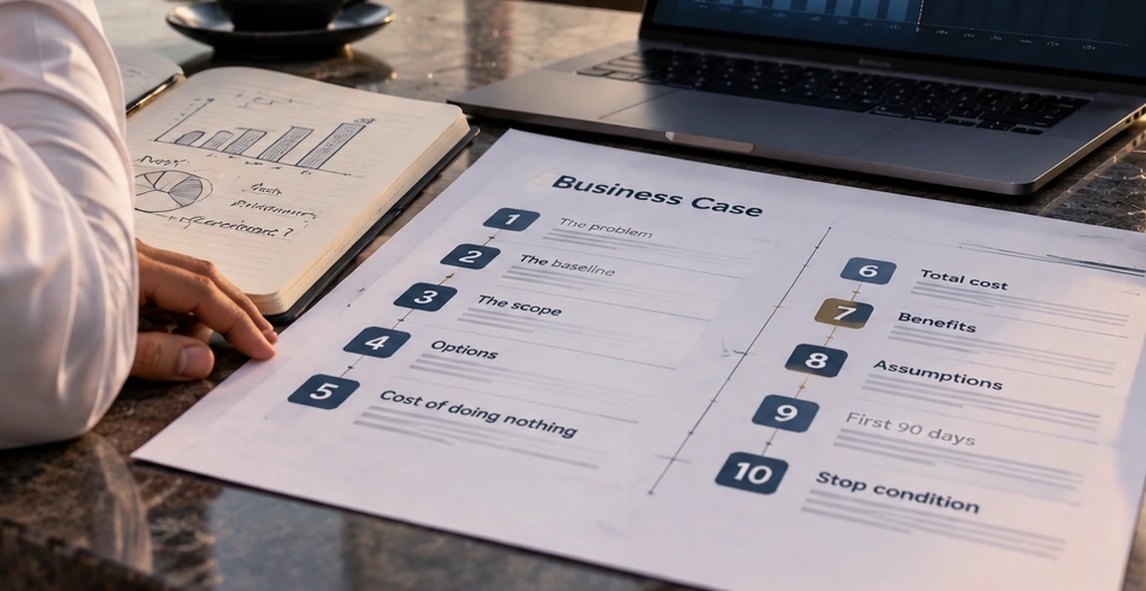
- How do I get the replacement approved and funded? The transformation business case guide.
How AY works
In modernization work, the order we recommend and work to is: inventory the systems and what reads from each, map the dependencies because that is what sets the sequence, assign a verdict per system with a named owner, and treat retirement as work with its own requirements rather than an administrative step.
The scope and outputs of any assessment are agreed per engagement. Examples are in our work, and the scope is set out in enterprise digital transformation.
This article is not a substitute for regulatory review: which requirements apply to a specific organisation depends on its activity and its data.
Next step
Triage five systems this week. Choose them by the constraints set out above — anything under an applicable deadline, carrying a security or continuity exposure, or running unsupported — and only then by business value. Give each one a verdict, a named owner, and a review date where the verdict is Extend. This initial triage is often suitable for one focused session and may not require anyone outside your organisation.
If you cannot assign verdicts because the dependencies are undocumented, that is the point at which involving an outside party becomes useful. Talk to us about whether an assessment fits your case and what it would cover — the scope and outputs of any assessment are agreed before it starts rather than assumed in advance.
0 Comments
No comments yet. Be the first to comment!
Related Blogs
What a Digital Modernization Company Does, and Which Type Fits Your Gap
Three kinds of firm sell digital modernization and they cover different layers. Identify the layer your gap sits in, then ask every candidate for the same five pieces of evidence.

The Digital Transformation Business Case: How to Get It Approved, and When to Stop
Proposals are declined when the return is asserted and no condition for abandoning the work exists. A ten-section template, a three-tier benefit split, and a stop condition you write yourself.

Build or Buy: Choosing a Digital Transformation Provider Without Outsourcing the Wrong Thing
Decide which capabilities should sit outside your organisation before comparing providers. Three questions per capability, conditional verdicts, and the costs an in-house comparison usually omits.

How to Choose a Digital Transformation Company in Saudi Arabia
Score your shortlist on twelve things visible before you sign, rather than looking for a ranking. Includes where AY scores itself lower.

The Digital Operating Model: Who Decides What After the Transformation
What separates two companies with the same systems is who decides what and when a decision escalates. A six-row decision rights map, and the latency indicator that shows whether it changed.

Digital Transformation Services in Saudi Arabia: What You Are Buying, and What Sets the Price
Three different things are sold under one name. Name the level, work through ten readiness questions, and understand the five factors that set the price before you request a proposal.